Translate

Wednesday, June 17, 2020

Sign the petition: Do not free Daniel Pearl's murderers


Pakistan must not free the murderers of Daniel Pearl!
Can anyone forget this journalist kidnapped in Pakistan on January 23, 2002?
Daniel Pearl, in charge of the Wall Street Journal office for Southern Asia, had come to the area to investigate ties between the so-called “Shoe Bomber”, British terrorist Richard Reid and the terrorist organization Al-Qaeda.
A terrorist group connected to Al-Qaeda as well as to ISI, Pakistan’s military secret services, claimed responsibility for taking Daniel Pearl hostage and making demands on the United States.
Daniel was murdered soon after.
His martyrdom is a symbol.
He was assassinated as a free man, as a journalist seeking to establish the truth, as an American, as a Jew. 
He was the first hostage whose beheading was staged and filmed by Islamist terrorists.
Many more were to follow.
In July 2002, three accomplices were sentenced to life imprisonment while the mastermind of the crime, Ahmed Omar Saïd Cheikh, was condemned to death. He has been in prison since that time.
A few wekkes ago, the High Court of Pakistan’s Sindh province commuted Omar's sentence to 7 years imprisonment and consequently ordered him and his accomplices to be set free!
Daniel Pearl's parents  have filed a petition and appealed to the Supreme Court.
We do hope that justice will prevail !
Our commitment has always been to defend freedom of thought and freedom of expression for the citizens of Pakistan.  We supported  Christian prisoner  Asia Bibi throughout her ordeal. We defend terror victims, democrats,  victims of the Blasphemy Law, ethnic and religious minorities submitted to repression.
Impunity granted to Daniel Pearl's murderers would be a terrible signal : murderers would roam freely whereas innocent people who neither killed nor harmed anyone would stay in prison and risk death.
This just cannot be !

Saturday, June 13, 2020

Douglas Murray: In defence of liberalism: resisting a new era of intolerance


Douglas Murray


It has become fashionable in recent years to talk of the death of liberalism. But as crowds high on the octane of generational self-righteousness rampage through major cities, the evidence mounts. The growing intolerance of freedom of thought, the inability to talk across divides, the way that most of the British establishment, police included, feels the need to pledge fealty to the cause — as though all terrified of ending up on the wrong side — points to a crisis of more than confidence. It is evidence of an underlying morbidity.

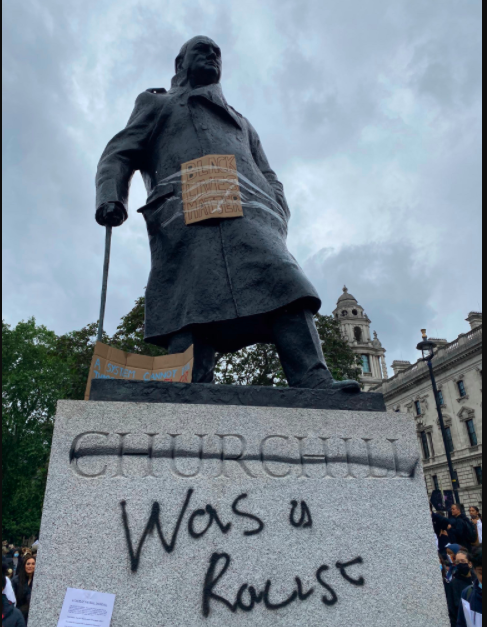
Each day the cultural revolution is picking up a pace, with the iconoclasts who attacked the Cenotaph and the statue of Winston Churchill looking for new focuses for their rage. The University of Liverpool has announced that its Gladstone halls of residence will be renamed after protestors pointed out that the former prime minister’s father had owned slaves. So there goes the ‘sins of the father’ ethic too. Nervous broadcasters have started removing programmes ahead of any stampede, with the BBC withdrawing Little Britain and HBO taking out Gone with the Wind from their streaming services in case the woke eye of Sauron flashes on them.

What we are seeing is nothing more or less than the death of the liberal ideal.

Of course ‘liberalism’ was always a broadly defined term; a definition made only vaguer by Americans making it synonymous with ‘left-wing’. But in the truest political sense it encapsulates most of the foundations of our political order, including (though not limited to) equality, the rule of law and freedom — including the freedom of speech that allows good ideas to win out. In the past few years, left-wing critics have been keen to identify what they see as the erasure of liberal democracy by popularly elected leaders on the political right. But in our own country, the much more serious assault on political liberalism comes not from the conservative right, but from the radical left.

Over the past couple of weeks, well-meaning people have poured almost a million pounds into the coffers of Black Lives Matter UK in the belief that they are helping a movement that will help black people. In fact they have funded a deeply radical movement. On its own fundraising page, BLM UK describes its aims as: ‘to dismantle imperialism, capitalism, white supremacy, patriarchy and the state structures.’ So as well as dismantling a nonexistent menace (‘imperialism’) it intends to bring down the economy and completely alter relations between the sexes (negatively characterised as ‘patriarchy’). This is not liberalism, but far-left radicalism of a kind that has become very familiar of late.

Some people watching events of recent days will have been surprised by how far and fast such sentiments have run. By the sight of a mob in Bristol tearing down a statue and then jumping on it. By a Labour MP saying: ‘I celebrate these acts of resistance. We need a movement that will tear down systemic racism.’ By the ranks of British police who could find no way to respond to this behaviour other than (in a newly invented act of faith) to ‘take the knee’ before it. And then there is the media, which has chosen to provide cover for such violence and purge from their ranks not just people who dissent from it but, in the case of the New York Times a few days ago, anyone who helps publish someone who dissents.

As one of the last liberals left at that newspaper, Bari Weiss, explained it last week, the over-forties in the news business (like so many others) imagined that the people coming up under them shared their liberal worldview. Then they discovered that these young people believed in ‘safetyism’ over liberalism, and ‘the right of people to feel emotionally and psychologically safe’ over ‘what were considered core liberal values, like free speech’. Actually the divide is even bigger than that, and now encompasses nearly everything. Where the liberal mind is inquiring, the woke mind is dogmatic. Where the liberal mind is capable of humility, the woke mind is capable of none. Where the liberal mind is able to forgive, the woke mind believes that to have erred just once is cause enough to be ‘cancelled’. And while the liberal mind inherited the idea of loving your neighbour, the woke mind positively itches to cast the first stone.

Readers of The Spectator have known this was coming. When this magazine first wrote about the Stepford Students, it was asked why we take this so seriously — surely the students would grow up? And they did: but they didn’t change. The virtue-signalling of large corporations — the growing legions of diversity officers and ‘implicit bias training’ — was also written off as the silliness of the corporate world. When we described the mandatory requirement in government to prove a ‘commitment to diversity’ in order to be eligible for any public appointment, it was greeted with the same dismissal. As the American journalist Andrew Sullivan (himself now seemingly muzzled, if not cancelled) put it two years ago: ‘We all live on campus now.’

Step by step, the UK came to have a public and private sector dedicated to the implementation of views which are barely distinguishable from those of the protestors who took to the streets in the past week or two. It’s an ethic which demands that our society play a set of impossible, unwinnable games of identity and ‘privilege’ that not only subvert but end any idea of tolerance.


All of this emanates from those who come out of university educated to loathe our society, believing it to be characterised by the oppression of certain groups by other groups: a shameful history and a shameful present. Today these people head into professions where their language of aggressive superiority (‘Educate yourself’) is used to intimidate their elders, force every-one to agree with their point of view and otherwise make themselves unsackable.

As with all movements that catch, they aren’t on to nothing. Inequalities and inequities do exist, here as in all societies. Reasonable people disagree about how to address this. But the new illiberal radicals do not share that worry. For them, every inequity that exists (financial, familial, social, neurological) is the result of the same thing: discrimination. A thing we must ‘tackle’, ‘eradicate’ and otherwise cleanse from existence. There’s an awful lot of work to do.

Even the woke analysis of history that now sees them scouring the land for more statues to assault is radically different from that of the liberal mind. Liberals understand that people in history acted with the knowledge they had at the time, and that the task of those looking back is to look on it with understanding, not least in the hope of being understood in turn. The woke mind abhors this. It knows that it is right, and that everybody before this year zero was a bigot. After the weekend’s vandalism against London monuments, the capital’s Mayor, Sadiq Khan, announced that his ‘Commission for Diversity in the Public Realm’ would sit in judgment on all racist statues in the capital. Within hours, the Museum of London had already brought in the cranes to remove an errant statue on West India Quay.

In such ways has the free exchange of ideas about our past and present been replaced by a series of demands and assertions that demand everyone else’s compliance. ‘Silence is violence’ is one favoured line, meaning that if you do not agree with the radicals, you are perpetrating an act of violence. Naturally this assertion comes from the same people who have spent a lot of time asserting that words (such as ‘mis-gendering’ someone) are violence. While the violence of the past few days is not violence.

It is on the lip of this trap that our representatives and public figures have teetered over the past week or two, unable to work out how they can avoid a step they intuit to be deadly. What they need to do is pause and fundamentally change the terms, basing their appeal not just on reason but on a truly liberal spirit. It should be one which emphasises that the claims being made are unjust. It is unjust to portray the whole of American society, in all of its complexity, as typified by a policeman who is awaiting trial for murder. And it is even more unjust to think that his actions reveal some deep truth about the British police, or the British state, let alone everybody who is white. Equally, it is not just unjust but vindictive to pretend that any contradiction of your world view is merely a display of ‘white privilege’, ‘white fragility’ or ‘white tears’.

Unwittingly or otherwise, those who use these terms subvert one of the last great additions to liberal thought: that aspiration expressed by Dr Martin Luther King half a century ago. For when Dr King talked about the need to judge a person by the content of their character and not by the colour of their skin, he gave us something that was not just a great moral insight but — in an increasingly diverse society — the only solution. A year before his death, Dr King gave a speech titled ‘Where do we go from here?’ in which he said: ‘Let us be dissatisfied until that day when nobody will shout, “White Power!”, when nobody will shout, “Black Power!”, but everybody will talk about God’s power and human power.’

The people who have come after Dr King have spent years busily inverting that dream. In the name of black agency they try to deny white people agency. In the name of assailing white supremacy they end up by asserting black supremacy. And in order to make up for the sufferings of people who are no longer alive they demand vast wealth transfers today based on racial grouping. It is hard to imagine a more divisive programme, all carried out in the name of anti-racism. What they are actually doing is busily re-racialising our societies. Which is how you come to the situation where a cabinet minister is quizzed on Sky News about the precise ethno-racial composition of the British cabinet and certain ‘anti-racists’ can be found on social media noting with disapproval the number of people of Asian descent in the cabinet.

Any movement that says ‘Things are so bad that this whole thing needs to be pulled down’ should be encouraged to realise, before they have to experience it, the cost of what they are abandoning. And to remember the central truth about how much easier it is to pull down than it is to build. They must be responded to by people of every skin colour and background with a polite but firm ‘No’. Not just because the things that they are attempting to pull down include the only things that are capable of holding us all up. But because if everything that got us here was so bad, then what we are living in wouldn’t be so unusually good.

Black Lives Matter vs Winston Churchill - whose side are you on?


I just wrote a letter to the Jerusalem Post regarding:   Open letter calls on Jewish organizations to endorse Black Lives Matter.

An open letter organized by three Jewish activists is calling on the Jewish community to take a number of actions, including endorsing Black Lives Matter. (June 13).  Published Friday, the letter has been signed by 52 people affiliated with Jewish organizations.

Yet a Black Lives Matter protester vandalized the statue of Winston Churchill in Parliament Square. He explained his motives:  “I tagged up the statue of Churchill because he's a confirmed racist. He fought the Nazis to protect the Commonwealth from invasion - he didn't do it for black people or for people of colour or for people of anything. He did it sheerly for colonialism. People will be angry - but I'm angry that for many years we have been oppressed”

In his December 31, 1999 column in the Washington Post, Charles Krauthammer wrote:

“Person of the Century? Time magazine offered Albert Einstein, an interesting and solid choice. Unfortunately, it is wrong. The only possible answer is Winston Churchill.

Why? Because only Churchill carries that absolutely required criterion: indispensability. Without Churchill the world today would be unrecognizable — dark, impoverished, tortured.

Take away Churchill in 1940, on the other hand, and Britain would have settled with Hitler — or worse. Nazism would have prevailed. Hitler would have achieved what no other tyrant, not even Napoleon, had ever achieved: mastery of Europe. Civilization would have descended into a darkness the likes of which it had never known.”

Jewish organizations are willing to endorse Black Lives Matter whose members desecrate the statue of the man who saved civilization from the “darkness the likes of which it had never known”.  This is shameful!  They have forgotten our collective history.

Mladen Andrijasevic

Be’er Sheva


Update, June 15, 2020:  Published as a Letter to the Editor in the Jerusalem Post

Sunday, June 7, 2020

Douglas Murray on the George Floyd protests, rioting & COVID hypocrisy


34:00 min into the Douglas Murray video:

You just can’t improve on what George Orwell said when he met a fanatic of a similar ilk.
One of my favorite stories of him was him debating with a Stalinist in the 1940s after the Ukraine famine, after the Show Trials, after 1937, after 1938, this is when you already knew everything you needed to know about comrade Stalin and Orwell is debating with this Stalinist and he concedes this, well yes, the trials and he goes on and on just refusing really to deal with every single one  of the issues  that have already come up and eventually says that great immortal getout for cowards across the centuries  -      “ you can’t make an omelet  without breaking eggs”  and George Orwell says to the Stalinist:  “Where’s the omelet?”

Winston Churchill statue vandalised as thousands attend Black Lives Matter rally


To me this shows better than anything else what these demonstrators stand for.  


Sunday, May 31, 2020

China and the Rhineland Moment


America and its allies must not simply accept Beijing’s aggression.


Great struggles between great powers tend to have a tipping point. It’s the moment when the irreconcilability of differences becomes obvious to nearly everyone.

In 1911 Germany sparked an international crisis when it sent a gunboat into the Moroccan port of Agadir and, as Winston Churchill wrote in his history of the First World War, “all the alarm bells throughout Europe began immediately to quiver.” In 1936 Germany provoked another crisis when it marched troops into the Rhineland, in flagrant breach of its treaty obligations. In 1946, the Soviet Union made it obvious it had no intention of honoring democratic principles in Central Europe, and Churchill was left to warn that “an iron curtain has descended across the Continent.”

Analogies between these past episodes and China’s decision this week draft a new national security law on Hong Kong aren’t perfect. Hong Kong is a Chinese port, not a faraway foreign one. Hong Kong’s people have ferociously resisted Beijing’s efforts to impose control, unlike the Rhineland Germans who welcomed Berlin’s. And the curtailment of freedom that awaits Hong Kong is nothing like the totalitarian tyranny that Joseph Stalin imposed on Warsaw, Budapest and other cities.


But the analogies aren’t inapt, either. Beijing has spent the better part of 20 years subverting its promises to preserve Hong Kong’s democratic institutions. Now it is moving to quash what remains of the city’s civic freedoms through a forthcoming law that allows the government to punish speech as subversion and protest as sedition. The concept of “one country, two systems,” was supposed to last at least until 2047 under the terms of the 1984 Sino-British Joint Declaration. Now China’s rulers have been openly violating that treaty, much as Germany openly violated the treaties of Locarno and Versailles. 

And again, alarm bells quiver.

For years, Donald Trump’s comments on China have swung between the truculent and the obsequious. But beneath the president’s mental foam, the administration has undertaken a sober rethink of the U.S. strategic approach to China, the outlines of which are described in a new interagency document quietly released by the White House last week. 


Gone from this new vision are the platitudes about encouraging China’s “peaceful rise” as a “responsible stakeholder” in a “rules-based order.” Instead, Beijing is described, accurately, as a habitual and aggressive violator of that order — a domestic tyrant, international bully and economic bandit that systematically robs companies of their intellectual property, countries of their sovereign authorities, and its own people of their natural rights.

“Beijing has repeatedly demonstrated that it does not offer compromises in response to American displays of goodwill, and that its actions are not constrained by its prior commitments,” the report reads. “We acknowledge and respond in kind to Beijing’s transactional approach with timely incentives and costs, or credible threats thereof.”

A critic might note that this description of China’s behavior sounds a lot like Trump’s. Sort of, except that the comparison trivializes the scale of China’s abuses and neglects the breadth and longevity of its challenge. A Biden administration will be confronted with the same unpleasant facts about a geopolitical adversary that seeks not only to dominate its region but also dethrone liberal democracy as the dominant political model of the 21st century.

All of which makes the Hong Kong crisis so consequential. Beijing almost certainly chose this moment to strike because it calculated that a world straining under the weight of a pandemic and a depression lacked the will and attention to react. On Friday, Trump said he would strip Hong Kong of its privileged commercial and legal ties to the U.S. But that punishes the people of Hong Kong at least as much as it does their rulers in Beijing.

What’s a better course for the U.S.? A few ideas:

Sanction Chinese officials engaged in human-rights abuses in Hong Kong under the Global Magnitsky Act. Upgrade relations with Taiwan and increase arms sales, including top-shelf weapons’ systems such as the F-35 and the Navy’s future frigate. Re-enter the Trans-Pacific Partnership agreement as a counter to China’s economic influence. (This won’t happen in a Trump administration, but should in a Biden one.) Publicly press all G-7 countries to stop doing business with telecom-giant Huawei as a meaningful response to the Hong Kong law.

One other idea is now being explored by Britain, the former colonial power. Give every Hong Kong person an opportunity to easily obtain a U.K. residency card, even a passport. As Tom Tugendhat, the chair of Parliament’s Foreign Affairs Committee and founder of its China Research Group, told me on Thursday, doing so would “right a wrong done when the U.K. removed the status in the 1980s. After a century of rule, Britain has obligations.” A future American president who believes in the value of immigration could join that effort, in the same way we helped Hungarian refugees and Vietnamese boat people.

If all this and more were announced now, it might persuade Beijing to pull back from the brink. In the meantime, think of this as our Rhineland moment with China — and remember what happened the last time the free world looked aggression in the eye, and blinked.

Friday, May 22, 2020

FT coronavirus tracker can now compare 6 countries in one go


I compared the countries which imposed the lock-down early on vs those which did not.


Worldometer  data from May 22, 2020 

Country
Early Lock-down
Deaths /1M
Sweden
  NO
389
US
  NO
294
UK
  NO
536
Norway
  YES
 43
Austria
  YES
 71
Israel
  YES
 32


From the interview with epidemiologist Marc Lipsitch here:      
              
Robert Wiblin: Yeah. What do you think of Sweden’s more laissez-faire approach?

Marc Lipsitch: I think it’s clearly killing more people than the neighbors. Having said that, I think that we’re almost all moving in that direction and that hopefully we can learn something from Sweden about what doesn’t work. But I think everybody is getting tired of being under restrictive policies and, I mean, Massachusetts so far has not reopened, but most states in the United States have begun to reopen and I think are heading in that direction. I think Sweden has, at great cost to themselves, demonstrated to the world that that’s costly.