Translate

Thursday, April 2, 2015

Mogherini’s nebulous statement

The official transcript is still not available. 


I'm going now to read a joint statement that we have agreed on with Foreign Minister Zarif and all the others that have been negotiating so hard in these days.

We, the European Union High Representative and the Foreign Minister of the Islamic Republic of Iran, together with the Foreign Ministers of the E3 + 3, China, France, Germany, the Russian Federation, the United Kingdom and the United States, met from 26 March to 2 April 2014 in Switzerland, as agreed in November 2013, to gather here to find solutions towards reaching a comprehensive solution that will ensure the exclusively peaceful nature of the Iranian nuclear program and the comprehensive lifting of all sanctions.

Today we have taken a decisive step. We have reached solutions on key parameters of a joint comprehensive plan of action. The political determination, the goodwill and the hard work of all parties made it possible and let us thank all delegations for their tireless dedication.

This is a crucial declaration laying the agreed basis for the final text of the joint comprehensive plan of action. We can now restart drafting the text and annexes of the joint comprehensive plan of action, guided by the solutions developed in these days.

As Iran pursues a peaceful nuclear program, Iran's enrichment capacity, enrichment level and stockpile will be limited for specific durations and there will be no other enrichment facility than Natanz.

Iran's research and development on centrifuges will be carried out on a scope and schedule that has been mutually agreed. Fordow will be converted from an enrichment site into a nuclear physics and technology center. International collaboration will be encouraged in agreed areas of research. There will not be any fissile material at Fordow.

An international joint venture will assist Iran in redesigning and rebuilding a modernized heavy water research reactor in Arak that will not produce weapons-grade plutonium. There will be no reprocessing, and spent fuel will be exported. A set of measures have been agreed to monitor the provisions of the JCPOA including implementation of the modified code 3.1 and provision of the additional protocol.

The International Atomic Energy Agency will be permitted the use of modern technologies and will have announced access through agreed procedures including to clarify past and present issues. Iran will take part in international cooperation in the field of civilian nuclear energy which can include supply of power and research reactors. Another important area of cooperation will be in the field of nuclear safety and security.

The European Union will terminate the implementation of all nuclear-related economic and financial sanctions and the United States will cease the application of all nuclear-related secondary economic and financial sanctions simultaneously with the IAEA-verified implementation by Iran of its key nuclear commitments.

A new UN Security Council resolution will endorse the JCPOA, terminate all previous nuclear-related resolutions, and incorporate certain restrictive measures for a mutually agreed period of time. We will now work to write the text of a joint comprehensive plan of action including its technical details in the coming weeks and months at the political and experts level. We are committed to complete our efforts by June 30.

We would like to thank the Swiss government for its generous support in hosting these negotiations, and let me personally and on behalf of everybody also thank you all, journalists and media from around the world, for having followed our work and somehow also worked with us over this difficult but intense and positive week.

Enrichment capacity still there - 5,000 centrifuges will remain spinning 
Sunset clause still there
PM Netanyahu will not be happy

Obama Cites Ayatollah’s Fatwa on Road to Nuclear War


Author:

As Iran continues edging closer to developing nuclear weapons—a major threat to the entire Mideast region, especially longstanding US ally Israel—US President Obama has come to the aid of the Islamic Republic, by citing an Islamic fatwa no less.  In a video recording posted on the White House’s website, Obama said, “Iran’s Supreme Leader Ayatollah Khamenei has issued a fatwa against the development of nuclear weapons, and President Rouhani has said that Iran would never develop a nuclear weapon.”

This is the same Rouhani who, after recently showcasing Iran’s newly developed missiles, described his nation’s diplomatic talks with the US as an active “jihad”: “Our negotiations with the world powers are a source of national pride. Yesterday [during the Iran-Iraq War], your brave generals stood against the enemy on the battlefield and defended their country. Today, your diplomatic generals are defending [our nation] in the field of diplomacy–this, too, is jihad.”

Other administration officials—such as Secretary of State John Kerry and Deputy National Security Adviser Ben Rhodes—have previously referred to the ayatollah’s reported fatwa in the context of the ongoing nuclear negotiations with Iran.
The Obama administration’s citation of this fatwa is utterly wrongheaded on many levels.
First, the Islamic doctrine of taqiyya permits Muslims to deceive non-Muslims. Islamic prophet Muhammad himself regularly lied to his infidel enemies, often resulting in their murder (such as the case of Ka‘b ibn Ashraf). He also proclaimed that lying was permissible in three contexts, one being war. Moreover, throughout the centuries and due to historic circumstances (discussedhere), taqiyya became second nature to the Shia—the sect currently ruling Iran.

Then there is the fact that Islamic law takes circumstance into account. When Muhammad was weak and outnumbered in Mecca, he preached peace and tolerance (hence why Meccan Suras appear peaceful); when he became strong in Medina, he preached war and went on the offensive (hence why Medinan Suras are violent and intolerant). This dichotomy—preach peace when weak, wage war when strong—has been Islamic modus operandi for centuries.
Speaking of fatwas, Dr. Yusuf Burhami, a prominent Islamic cleric in Egypt, recently said that destroying churches in Egypt is permissible if not advisable—but not if doing so prompts Western infidels to intervene and occupy Egypt, which they could do “because the condition of Muslims in the current era is well known to the nations of the world—they are weak.” Burhami further added that circumstance is everything, “just as the prophet allowed the Jews to remain in Khaibar after he opened [conquered] it, once Muslims grew in strength and number, [second caliph] Omar al-Khattab drove them out according to the prophet’s command, ‘Drive out the Jews and Christians from the Peninsula.’”

And who can forget Yasser Arafat’s reference to Muhammad’s Hudaybiya pact?  In 1994, soon after negotiating a peace treaty criticized as conceding too much to Israel, Arafat addressed an assembly of Muslims and said: “I see this agreement as being no more than the agreement signed between our Prophet Muhammad and the [infidel] Quraysh in Mecca.” In other words, like Muhammad, Arafat gave his word only to annul it once his ranks became strong enough to go on the offensive.
In short, it’s all very standard for Islamic leaders to say they are pursuing nuclear energy for peaceful purposes while they are weaker than their infidel foes—as Iran is today—but once they acquire nukes the jihad can resume in earnest.
Then there is the fact that Shia theology is rife with apocalyptic aspirations.  An August 2007 report compiled by the Congressional Research Service said: “Ahmadinejad [previous president of Iran] believes his mission is to prepare for the return of the 12th ‘Hidden’ Imam, whose return from occultation [i.e., “hiding”] would, according to Twelver Shi’ite doctrine, be accompanied by the establishment of Islam as the global religion.”

Like other Iranians, Ahmadinejad cited the eschatological (and canonical) hadith wherein Muhammad said: “The Hour [Judgment Day] will not come until the Muslims fight the Jews and until the Jews hide behind the trees and rocks and the trees and rocks will say, ‘O Muslim, O Servant of God! Here are the Jews! Come and kill them!”
Indeed, during a recent speech, supreme leader Khamenei—whose fatwa Obama is now citing—boasted about Iran’s uranium enrichment, even as his military commanders shouted, “Allah Akbar. Khamenei is the leader. Death to the enemies of the leadership. Death to America. Death to England. Death to hypocrites. Death to Israel.”
Yet despite all this—despite the fact that Islamic doctrine mandates lying to infidels; despite the fact that the Shia—Iran’s leadership—have perfected taqiyya into an art; despite the fact that Islamic law holds that Muslims should preach peace when weak, war when strong; despite the fact that Iranian leadership openly boasts that its nuclear negotiations are a “jihad” against the infidel; despite the fact that Iran has previously been exposed developing uranium enrichments suitable for nuclear warheads—here is Obama and his administration relying on the “word” of the ayatollah of Iran.

Raymond Ibrahim is author of Crucified Again: Exposing Islam’s New War on Christians.  A Mideast and Islam specialist, he is a Shillman Fellow at the David Horowitz Freedom Center, an associate fellow at the Middle East Forum, and a Hoover Institution Media Fellow, 2013.

Wednesday, April 1, 2015

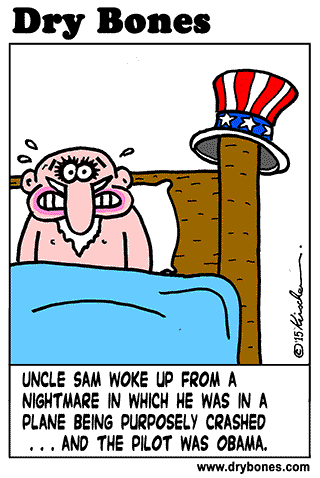
Dry Bones: Nightmare


Letters to the Editor: April 2, 2015

US President Barack Obama is acting like the co-pilot who seems to have deliberately crashed the Germanwings airliner last week. By appeasing Iran, he is driving the world into a fatal descent toward nuclear war. Congress is knocking on the cockpit door, but to no avail.

Congress should break down the door while there is still time.

MLADEN ANDRIJASEVIC Beersheba 

Statement by PM Netanyahu on the Lausanne Talks


Transcript:

Yesterday an Iranian general brazenly declared and I quote: 'Israel's destruction is non-negotiable' . But evidently giving Iran's murderous regime a clear path to the bomb is negotiable.

This is unconscionable.

I agree with those who have said that Iran's claim that its nuclear program is only for peaceful purposes doesn't square with Iran's insistence on keeping underground nuclear facilities, advanced centrifuges and a heavy water reactor. Nor does it square with Iran's insistence  on developing ICBMs and its refusal to come clean with the IAEA on its past weaponization efforts. At the same time, Iran is accelerating its campaign of terror, subjugation and conquest throughout the region, most recently in Yemen.

The concessions offered to Iran in Lausanne would ensure a bad deal that would endanger Israel, the Middle East and the peace of the world.

Now is the time for the international community to insist on a better deal. A better deal would significantly roll back Iran's nuclear infrastructure. A better deal would link the eventual lifting of the restrictions of Iran's nuclear program  to  a change in  Iran's behavior.

Iran must stop its aggression in the region, stop its terrorism throughout the  world and stop its threats to annihilate Israel . That should be non-negotiable, and that's the deal that the world powers must insist upon.

Tuesday, March 31, 2015

Netanyahu catches Obama in Iran-nuclear flip-flop

PM points out elements "apparently" in nuclear deal that Obama said last year are things that Iran does not need in order to have a peaceful program.


Prime Minister Benjamin Netanyahu's pre-election flip flop on a two state solution, which he later walked-back, will pale in comparison to a US presidential zig-zag if Netanyahu reported accurately to the Knesset on Tuesday on what will be in the nuclear accord being negotiated in Lausanne.

“The biggest threat to our security and our future was and remains Iran's attempts to arm with nuclear weapons,” Netanyahu said 
at the ceremonial opening of the 20th Knesset just hours before the self-imposed deadline for reaching a framework deal between the world powers and Iran.

“The agreement being put together in Lausanne paves the way for that result. Apparently it will leave in Iran's hands underground facilities, the [hard-water] reactor at Arak, advanced centrifuges. All those things that only a few months ago we were told, rightfully so, that they were not vital to a peaceful nuclear program.”

It was US President Barack Obama who said that each of those elements was not needed for a peaceful program.

Obama, during a question-and answer session at the Saban Forum at the Brookings Institution in Washington in December 2012, 
said the following:

In terms of specifics, we know that they don’t need to have an underground, fortified facility like Fordow in order to have a peaceful nuclear program.

“They certainly don’t need a heavy-water reactor at Arak in order to have a peaceful nuclear program.  They don’t need some of the advanced centrifuges that they currently possess in order to have a limited, peaceful nuclear program,” Obama said at the time.

Netanyahu chose his words carefully, saying these elements will “apparently” be in the agreement, since the details of the deal are still being worked out, and have not been released

Monday, March 30, 2015

The Capitulationist

The Obama administration refuses to negotiate openly, lest the extent of its diplomatic surrender to Iran be prematurely and fatally exposed.


   By BRET STEPHENS


For a sense of the magnitude of the capitulation represented by Barack Obama’s Iran diplomacy, it’s worth recalling what the president said when he was trying to sell his interim nuclear agreement to a Washington, D.C., audience in December 2013.
“We know they don’t need to have an underground, fortified facility like Fordo in order to have a peaceful program,” Mr. Obama said of the Iranians in an interview with Haim Saban, the Israeli-American billionaire philanthropist. “They certainly don’t need a heavy-water reactor at Arak in order to have a peaceful nuclear program. They don’t need some of the advanced centrifuges that they currently possess in order to have a limited, peaceful nuclear program.”
Hardly more than a year later, on the eve of what might be deal-day, here is where those promises stand:
Fordo: “The United States is considering letting Tehran run hundreds of centrifuges at a once-secret, fortified underground bunker in exchange for limits on centrifuge work and research and development at other sites.”—Associated Press, March 26.
Arak: “Today, the six powers negotiating with Iran . . . want the reactor at Arak, still under construction, reconfigured to produce less plutonium, the other bomb fuel.”—The New York Times, March 7.
Advanced centrifuges: “Iran is building about 3,000 advanced uranium-enrichment centrifuges, the Iranian news media reported Sunday, a development likely to add to Western concerns about Tehran’s disputed nuclear program.”—Reuters, March 3.
But the president and his administration made other promises, too. Consider a partial list:
Possible military dimensions: In September 2009 Mr. Obama warned Iran that it was “on notice” that it would have to “come clean” on all of its nuclear secrets. Now the administration is prepared to let it slide.
“Under the new plan,” The Wall Street Journal’s Jay Solomon and Laurence Normanreported last week, “Tehran wouldn’t be expected to immediately clarify all the outstanding questions raised by the IAEA in a 2011 report on Iran’s alleged secretive work. A full reckoning of Iran’s past activities would be demanded in later years as part of a nuclear deal that is expected to last at least 15 years.”
Verification: Another thing the president said in that interview with Mr. Saban is that any deal would involve “extraordinary constraints and verification mechanisms and intrusive inspections.”
Iran isn’t playing ball on this one, either. “An Iranian official on Tuesday [March 24] rebuked the chief of the U.N. atomic agency for demanding snap inspections of Iran’s nuclear sites, saying the request hindered efforts to reach an agreement with the world powers,” reports the AP. But this has done nothing to dent the administration’s enthusiasm for an agreement.
“It was never especially probable that a detailed, satisfactory verification regime would be included in the sort of substantive framework agreement that the Americans have been working for,” the Economist noted last week.
Ballistic missiles: In February 2014, Wendy Sherman, the lead U.S. negotiator, testified to Congress that while the interim agreement was silent on Iran’s production of ballistic missiles, “that is indeed going to be part of something that has to be addressed as part of a comprehensive agreement.” This point is vital because ballistic missiles are a central component of a robust nuclear arsenal.
Except missiles are off the table, too. “Diplomats say the topic [of missiles] has not been part of formal discussions for weeks,” the AP reported Monday.
Break-out: President Obama has repeatedly insisted that the U.S. will only sign a deal that gives the U.S. and its allies a year’s notice if Iran decides to “break out” and go for a bomb.
But if the Iranians won’t come clean on their past weapons’ work, it’s impossible to know how long they would really need to assemble a bomb once they have sufficient nuclear material.
Nor does the one-year period square with the way Iran would try to test the agreement: “Iran’s habit of lulling the world with a cascade of small infractions is an ingenious way to advance its program without provoking a crisis,” Michael Hayden, the former CIA director, wrote with former IAEA deputy chief Olli Heinonen and Iran expert Ray Takeyhin a recent Washington Post op-ed. “A year may simply not be enough time to build an international consensus on measures to redress Iranian violations.”

***

Some readers may object that Iran has made its own significant concessions. Except it hasn’t. They may also claim that the U.S. has no choice but to strike a deal. Except we entered these negotiations with all the strong cards. We just chose to give them up.
Finally, critics may argue that I’m being unfair to the administration, since nobody knows the agreement’s precise terms. But that’s rich coming from an administration that refuses to negotiate openly, lest the extent of its diplomatic surrender be prematurely and fatally exposed.
Nearly a century ago Woodrow Wilson insisted on “open covenants of peace, openly arrived at, after which there shall be no private international understandings of any kind but diplomacy shall proceed always frankly and in public view.” Barack Obama prefers to capitulate to tyrants in secret. Judging from the above, it’s no wonder.

Saturday, March 28, 2015

Iranian Defector: 'U.S. Negotiating Team Mainly There to Speak on Iran’s Behalf'


An Iranian journalist writing about the nuclear negotiations between the United States and Iran has defected. In an interview Amir Hossein Motaghi, has some harsh words for his native Iran. He also has a damning indictment of America's role in the nuclear negotiations.

“The U.S. negotiating team are mainly there to speak on Iran’s behalf with other members of the 5+1 countries and convince them of a deal," Motaghi told a TV station after just defecting from the Iranian delegation while abroad for the nuclear talks. The P 5 + 1 is made up of United States, United Kingdom, Russia, China, France, plus Germany.

A close media aide to Hassan Rouhani, the Iranian president, has sought political asylum in Switzerland after travelling to Lausanne to cover the nuclear talks between Tehran and the West.

Amir Hossein Motaghi, who managed public relations for Mr Rouhani during his 2013 election campaign, was said by Iranian news agencies to have quit his job at the Iran Student Correspondents Association (ISCA).
He then appeared on an opposition television channel based in London to say he no longer saw any “sense” in his profession as a journalist as he could only write what he was told.

“There are a number of people attending on the Iranian side at the negotiations who are said to be journalists reporting on the negotiations,” he told Irane Farda television. “But they are not journalists and their main job is to make sure that all the news fed back to Iran goes through their channels.


“My conscience would not allow me to carry out my profession in this manner any more.” Mr Mottaghi was a journalist and commentator who went on to use social media successfully to promote Mr Rouhani to a youthful audience that overwhelmingly elected him to power.