Thursday, February 3, 2022
Tuesday, February 1, 2022
Israel and the Ukraine-Russia conflict
Authoritarian
2: of, relating to, or favoring a concentration of power in a
leader or an elite not constitutionally responsible to the people
: of or relating to a political regime based on
subordination of the individual to the state and strict control of all
aspects of the life and productive capacity of the nation especially by
coercive measures (such as censorship and terrorism)
Letters to the Editor,
January 31, 2022
Amotz Asa-El
contends that Israel must not take sides in the Ukraine-Russia conflict. He is
dead wrong. For two reasons. Russia is part of the new
authoritarian/totalitarian axis consisting of Russia, China and Iran in which
Iran is an existential threat to Israel. So it would be quite hypocritical to
ignore one aggression and then expect others to condemn Iran when it threatens
with the annihilation of Israel.
Second,
Israel is a democracy and should side with democracies against dictatorships.
Wars are very rarely fought between democracies. NATO is not a threat to Russia
and never has been. It was formed as a defensive alliance and Putin is
manufacturing the threat to justify the intervention in Ukraine because a
democratic and successful Ukraine would be an example that Russians would want
to emulate.
The
whole situation eerily reminds me of the Sudetenland crisis in 1938, and the
reaction of the West has not been much better today than it was then.
MLADEN ANDRIJASEVIC
Beersheba

Sunday, December 19, 2021
Has Israel gone overboard fighting COVID19? No, it has not!
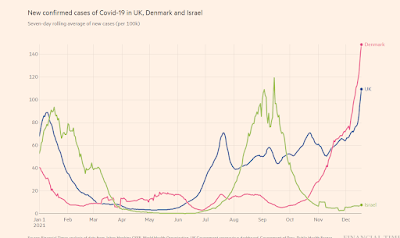
Letters
to the Editor, Jerusalem Post, December 20, 2021
Gone overboard?
Regarding “Has
Israel gone overboard fighting COVID-19?” (editorial, December 17), no, it
has not! It seems Jerusalem Post staff cannot grasp the concept of exponential
growth and what it means that Omicron in the UK has an R between 3 and 5
compared to Delta’s R, which is between 1.1 and 1.2.
Hospitalization lags two to three weeks
after infection so we do not know yet the actual severity of Omicron.
But even if Omicron were less severe than
Delta, Omicron’s transmissibility is much higher than Delta’s. Dr. Eric Topol described the
situation as such: “A key point here is that high transmissibility, which we
are clearly seeing, will get a lot more people infected. Even if a smaller
fraction do get severe illness, that’s still a lot more people very sick. That
also means more Long COVID, too, which can occur with mild cases and can be
quite disabling.”
The proof that Israel has not gone
overboard is the story in the Post itself: “One
family likely causes mass Omicron outbreak” (December 19).
MLADEN ANDRIJASEVIC
Beersheba
Monday, November 29, 2021
Liz Truss and Yair Lapid: Together we can propel both our nations to safety and prosperity
By Liz Truss and Yair Lapid, Israeli
foreign minister
Many fear the skies are darkening worldwide
due to the pandemic, the threat of terrorism and hostile actors seeking the
upper hand. But we believe that with the right approach, freedom and democracy
will prevail over malign forces.
That is why Israel and the United Kingdom
are today coming together in London to take a major step forward: transforming
our close friendship into an even closer partnership by formally agreeing a new
strategic plan for the next decade spanning cyber, tech, trade and defence.
This pact will spur technological
breakthroughs which have the potential to change the world, create high-quality
jobs in both our countries and provide tools to our security forces. But more
than that, it is a victory for optimism.
We believe that a democracy rooted in
freedom - which empowers citizens with the opportunity to innovate, create, and
fulfill their dreams - is the finest form of government. As outward-looking
patriotic nations, we know that the best way forward lies in building stronger
economic, technological and security ties with like-minded partners.
Our great nations can do so much more to
create jobs and fuel economic growth
Our recovery from the pandemic will be
fuelled by free enterprise, free trade, and investment. We have built up a
trading relationship worth £5 billion, led by companies like Rolls-Royce
supplying jet engines to Israel’s national airline and the Israeli
pharmaceutical giant Teva now providing one in six of the NHS’ prescription
medicines.
But our great nations can do so much more
to create jobs and fuel economic growth. That is why we will pave the way to
negotiating a bespoke UK-Israel free trade agreement, which would help us seize
new opportunities in the industries of the future like services, science and
technology.
We know the opportunities of the future
will come from technology, which is why Israel and the UK are going further and
faster to push new frontiers of innovation. Our partnership will keep us at the
forefront of the technological revolution and maximise our competitive
advantage. The UK will also open its doors to high-growth Israeli tech firms,
offering a gateway for them to realise their ambitions in areas like AI and
quantum computing.
With the world increasingly threatened in
cyberspace, we will work closer to defend ourselves. Israel will officially
become a Tier One cyber partner for the UK, recognising how much more we can
achieve together as tech leaders with world-class cybersecurity expertise.
This is testament to the forward-leaning
ethos at the heart of Israel and the UK’s partnership. Chaim Weizmann, Israel’s
first president, was also a renowned scientist who once lectured at the
University of Manchester. He said: “Science will bring to this land both peace
and renewal of its youth.”
As science and tech superpowers, Israel and
the UK are putting our prowess into action, leading the world in our vaccine
rollouts and in developing billion dollar tech unicorns. It is no surprise that
the UK was the first country to establish a special mission to Israel to boost
tech cooperation, helping us set the standard for modern business.
We stand united in condemning the appalling
attacks on Israel and its representatives
Of course, we know the world has to be safe
for freedom-loving democracies. That is why we are working robustly as security
partners. Our air forces now conduct regular exercises and HMS Richmond showed
the strength of our ties when docking in the crystal blue waters of Haifa’s
port, as part of the Carrier Strike Group’s global deployment.
We stand united in condemning the appalling
attacks on Israel and its representatives, from the shooting in Jerusalem last
week by a Hamas militant to the unacceptable hounding of Israel’s ambassador
Tzipi Hotovely outside the London School of Economics.
There is no place for anti-Semitism around
the world. That is why the UK has moved decisively to support Israel in this
fight by proscribing Hamas in its entirety. The Holocaust Memorial and Learning
Centre planned near Parliament will stand as a constant reminder, and answer to
the question of why we must stamp out anti-Semitism and hate wherever and
whenever it is found.
We will also work night and day to prevent
the Iranian regime from ever becoming a nuclear power. The clock is ticking,
which heightens the need for close cooperation with our partners and friends to
thwart Tehran’s ambitions.
There is no greater sign of what can be
achieved through open dialogue than the Abraham Accords. The UK was one of the
first countries to publicly celebrate this historic step towards normalisation
in the Middle East led by Israel, the United Arab Emirates, Bahrain and Morocco
and mediated by the United States. One year on, the UK is continuing to play
its part in supporting Israel as it works more closely with partners in the
region.
Israel and the UK are the closest of
friends, and today we are deepening that partnership to become even closer.
Together, we will forge ahead and ensure the future is defined by liberal
democracies who believe in freedom and fairness.
Wednesday, November 24, 2021
Topol and Osterholm: The CDC got it wrong. It should have urged all adults to get covid-19 booster shots.

By Eric J. Topol and Michael T. Osterholm
Eric J. Topol is a professor of molecular medicine at Scripps Research. Michael T. Osterholm is Regents Professor and director of the Center for Infectious Disease Research and Policy at the University of Minnesota.
Even though the United States is experiencing a new surge of covid-19, the Centers for Disease Control and Prevention’s Advisory Committee on Immunization Practices recommended last week that all adults be made eligible for booster shots but only urged shots for people older than 50.
That was a big mistake. It should have urged all adults to get them.
Public health officials have always expected that mRNA coronavirus vaccines (Moderna and Pfizer/BioNTech) to be a three-shot regimen. The only question was when the third shot would be necessary. Originally, the hope was that it would be after one or two years. It turns out, it is necessary at about six months.
More than 10 large reports have shown that the reduced protection from infections, including symptomatic infections, across all age groups, wanes from 90 to 95 percent at two months down to about 60 percent for Pfizer and 70 percent for Moderna after five to six months. There is further substantial waning after six months.
The
good news is that a booster dose can restore that initial efficacy, as data
makes abundantly clear. One randomized trial of
Pfizer’s vaccine involving more than 10,000 participants — half receiving a
third shot and the other half receiving a placebo booster — showed a remarkably
high 95-percent efficacy. In that trial, people aged 18 to 55 benefited just as
much as those older than 55. There were no safety issues raised, such as
myocarditis.
It
is important to underscore that for all coronavirus vaccine trials, symptomatic
infection has been the primary endpoint, and has tracked well with
hospitalizations and deaths. Large, randomized trials are rightly considered
the gold standard form of evidence. There are no other randomized trials of
booster shots underway.
Israel offers more evidence of
the booster’s benefits. Its largest health system tracked more than 700,000
people who had received a booster shot and found that the third shot had a
striking 91 percent effectiveness against symptomatic infection. It also had a
93 percent effectiveness against hospitalization and 81 percent effectiveness
against covid-related deaths.
But
the CDC’s advisory committee didn’t review this important observational study
and many other relevant data sources. If it had, perhaps it would have more
forcefully advocated boosters for all adults. Our recommendation is fully
consistent with messaging from the White House and President Biden that all
vaccinated adults should get boosters.
Its
failure to do so has substantial implications. Only 59 percent of
the U.S. population is fully vaccinated, meaning the United States ranks below
the top 50 most-vaccinated countries. Countries throughout Europe, such as
Denmark and Belgium, have vaccination rates of around 75 percent, and even they
are experiencing record-setting surges in cases.
Like Britain and Israel, the United States was a first mover
with early vaccination campaigns, so it has a much higher proportion of people
with waning immunity. Forty percent of Americans (more than 120 million people)
were fully vaccinated by June 1 and have diminished protection. Each day in the
United States, the number of people with waning immunity greatly exceeds those
who are getting newly vaccinated. Accordingly, rather than building our wall of
population immunity, the United States is suffering attrition.
It has been
estimated that more than 90 percent of Americans need to be
fully vaccinated to contain the hyper-contagious delta variant. Not only are we
far from that goal, but also we are moving in the wrong direction. While we
continue to press ahead to reach unvaccinated Americans, we must concurrently
maintain protection for those who have received the shot.
This is especially concerning amid the new surge, which has been
labeled a “pandemic of the unvaccinated.” This is misleading; it is critical to
recognize the category of “vaccinated but waned.” Multiple studies have shown
that fully vaccinated people can spread the delta variant. This is more likely
when the vaccine-induced immune response has faded. Since booster shots
strongly reduce symptomatic infections, they could help stem the increased
spread that we are experiencing.
Israel used booster shots for all
adults as its principal — and highly effective — strategy to manage its worst
surge of the pandemic. There, the status of “fully vaccinated” is defined as
having received three shots. Indeed, the United States has consistently ignored
critical lessons from Israel and Europe throughout the pandemic.
By
not strongly urging all fully vaccinated adults to get a third
shot, the CDC has failed its responsibility to protect the public,
fundamentally missing a strategy that would limit the surge in cases — not to
mention the toll it will have in terms of long covid-19 and hospitalizations.
It has also engendered confusion by not keeping its recommendation simple,
suggesting an illusion that there is a sharp age gradient for the benefit of
boosters, which is clearly not the case.
Now, as we confront yet another surge, it is not the time to withhold a vital and validated means of boosting our efforts to contain the virus.
Saturday, November 20, 2021
Michael Oren: Why Israel may soon attack Iran

The world's largest state-sponsor of
terror, sworn to destroy Israel, is approaching the nuclear threshold. It's not
an existential threat for the US. It is for Israel.
Later this month, representatives of the world powers and Iran will meet in Vienna to discuss reviving the 2015 Joint Comprehensive Plan of Action Cooperation – the Iran nuclear deal. In the runup to the talks, the United States and Israel have reiterated their determination to prevent Iran from producing nuclear weapons. Both have stated their preference for a diplomatic means of achieving that goal. But there the symmetry ends. While the United States can live with an Iran that has the ability to make a bomb but doesn’t do so, Israel simply cannot.
The disparity was clear at a recent press conference with Secretary State Anthony Blinken and Israeli and Emirati counterparts. Blinken reiterated his administration’s longstanding insistence that “Iran cannot be allowed to acquire a nuclear weapon.” By contrast, Israeli Foreign Minister Yair Lapid warned that “Iran is becoming a nuclear threshold country,” and that Israelis “have no intention of letting this happen.”
What is the difference between an Iran that could
quickly make a bomb and an Iran that already has one? Why would America
implicitly accept a threshold-capable Iran while Israel regards it as a
strategic – and potentially existential – threat?
“Threshold” describes a nuclear program that has all the components
necessary for swiftly making a bomb. Enriching uranium to the 90% level
necessary for weaponization takes as much as two years. But by enriching
uranium to 60%, as it does now, Iran has completed the longest stretch of the
process and is now installing centrifuges capable of spinning four or even six
times faster than the current rate. Once it decides to break out and create a
nuclear arsenal, Iran can do so in a matter of weeks or even days – well before
the international community could react.
And Iran will inevitably break out. Several
countries have what is sometimes called “Japan-like capabilities,” a reference
to Japan’s own threshold nuclear program. But Japan is not Iran, a country
ruled by the world’s largest state-sponsors of terror, which works to overthrow
pro-Western governments, and vows to wipe Israel off the map. Having the
ability to make a bomb, no matter how quickly, will not suffice for Iranian
rulers. They saw what happened to Saddam Hussein in Iraq and Libya’s Muammar
Qaddafi, both of whom forfeited their nuclear ambitions and died, and what
didn’t happen to Kim Jung-un, who kept his and become almost untouchable. Yet,
beyond regime survival, the bomb is vital for Iranian prestige. A weapon
possessed by Sunni Pakistan, Hindu India, and, presumably, by the Jewish State
cannot be denied to the Shiite Islamic Republic.
Yet Iran does not have to possess the bomb to
damage Israel irreparably. Threshold capacity provides Iranian-backed
terrorists with a nuclear umbrella that can open and shield them from
retaliation. Responding to rocket attacks from Hezbollah or Hamas, Israel will
be hobbled by the fear of an Iranian breakout. Defending the country will be
dangerously more difficult.
Such fears are much less pronounced in the United
States, a country situated far from Iran and not threatened with national
destruction – a United States which, moreover, has no desire to become
embroiled in another overseas conflict. For that reason, the Biden
Administration pledges to prevent Iran from acquiring nuclear weapons but not
to prevent Iran from attaining the ability to make them. For that reason,
President Biden vows to consider “other options” should Iran not return to the
negotiating table but does not echo President Obama’s warnings of “all options
are on the table,” including a military strike.
Israelis view this policy with profound skepticism.
A threshold Iran will drive other Middle Eastern states to attempt to achieve
the same capability, creating a highly unstable region teetering on a nuclear
threshold. Together with its continuing efforts to produce a deliverable
warhead – amply documented by the nuclear archive Israel’s Mossad secreted out
of Teheran – Iran has developed intercontinental ballistic missiles that can
already hit central Europe and will eventually reach the North American coast.
Global security will be undermined.
For Israel, though, the timetable for action is
much shorter, and while our military capabilities cannot equal America’s, we do
have the means to defend ourselves. And though Israel has no expectations of US
military intervention, we trust that the United States will provide us with the
logistical, diplomatic and legal assistance we need and stand by all its Middle
Eastern allies. Doing so will not only deal a decisive blow to Iran’s nuclear
ambitions but will also restore America’s regional prestige.
As the nuclear talks resume, Israel will be
watching to see if Iran exploits them to camouflage its march toward threshold
capability. If so, irrespective of the international backlash, Israel will be
forced to act. Recalling that both he and the Secretary of State are the sons
of Holocaust survivors, Lapid stressed the need for nations to protect
themselves against evil, and especially against an Iran sworn to destroy the
Jewish state. “Israel reserves the right to act at any given moment, in any
way,” he said. America, and the world, should listen.
ABOUT THE AUTHOR
Michael Oren was formerly Israel’s ambassador to the United States, a Member of Knesset, a deputy minister in the Prime Minister’s Office. His latest book is, To All Who Call in Truth (Wicked Son, 2021).
****
Michael Oren is the only Israeli politician apart from Bibi who quoted Bernard Lewis's warning on Iran and MAD:
Michael
Oren: Why Obama is wrong about Iran being 'rational' on nukes
As famed Middle East scholar Bernard Lewis once observed, “Mutually assured destruction” for the Iranian regime “is not a deterrent — it's an inducement.”
***
****
It was already clear in 2008 that this would
happen. My article from then:
Tuesday, November 16, 2021
Not Mata Hari
 |
| Mata Hari |
 |
| Richard Sorge |
 |
| Eli Cohen |
Jerusalem
Post Letters to the Editor, November 17, 2021
Not Mata
Hari
Regarding “Turkey
allows visit by consul to jailed Israeli couple” (November 16), this whole
incident is just too much. For heaven’s sake, if Israel can assassinate Mohsen
Fakhrizadeh using a computerized machine gun, bring from Iran half a ton of
nuclear files, disrupt the centrifuges through Stuxnet, then surely it does not
need to photograph Erdogan’s palace from a TV tower.
We do not
live in the times of Mata Hari and invisible ink, not even in the times of
Richard Sorge or Eli Cohen, so what the Israeli media should have done is
demonstrate how absurd the Turkish claims are.
It is also
high time that Israelis become more conscious of the character of the countries
they go on vacation to. Why pick one ruled by an Islamic fundamentalist with a
very antagonistic attitude toward Israel when they can choose from a number of
Mediterranean democracies? Appeasing dictators is never a good policy and that
applies not only to governments but to their citizens too.
MLADEN
ANDRIJASEVIC
Beersheba
And here are
the Mediterranean
democracies Israelis could pick to go on vacation
to instead of Turkey. Note that it applies only to The Republic of Cyprus and no the Turkish Republic of Northern
Cyprus

Subscribe to:
Posts (Atom)