Translate

Friday, June 26, 2015

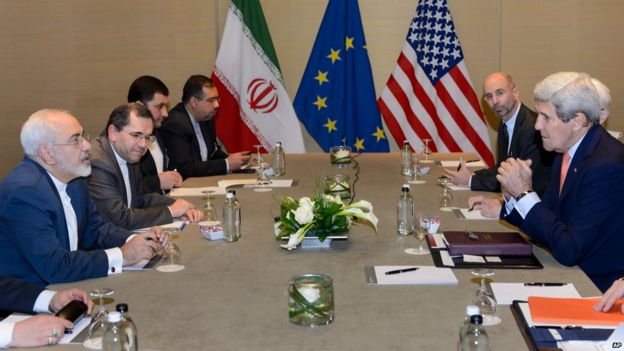
The Iranian-American nuclear project

If the US fails to reverse Obama’s policies toward Iran in the next two years, it is hard to see how it will be able to rebuild its strategic posture in the future.


Under President Obama, the US has implemented policies toward Iran that are catastrophic for Israel specifically, for US Middle East allies more generally and for US national security itself.

Consider, first, the known details of the soon-to-be- concluded nuclear deal.

In an article published by The New York Times this week, Prof. Alan Kuperman explained that Obama’s central justification for the agreement – that it will lengthen Iran’s breakout time to the bomb from the current two months to 12 months – is a lie.  

Based on nothing more than the number of centrifuges Iran will be allowed to possess and the amount of enriched uranium necessary to make a nuclear bomb, Kuperman demonstrated that far from prolonging Iran’s nuclear breakout time by 10 months, the deal will only prolong its breakout time by one month. In other words, the deal is worthless.

Actually it’s worse than worthless.

Wednesday, the Associated Press reported on the details of one of the agreement’s five secret annexes.

Titled “Civil Nuclear Cooperation,” the annex demonstrates that, far from merely failing to block Iran’s development of nuclear weapons, the deal will facilitate Iran’s development of nuclear weapons.

The leaked secret annex has two central components.

The first involves the underground uranium- enrichment facility at Fordow. Built inside a mountain, the Fordow complex is considered resistant to air strikes.

According to the AP report, the Iranians have agreed to re-purpose the installation from uranium enrichment to isotope production. In turn, the six powers have agreed to provide the Iranians with next-generation centrifuges to operate it. Yet, as the AP report makes clear, “isotope production uses the same technology as enrichment and can be quickly re-engineered to enriching uranium.”

In other words, the six powers will teach Iran how to operate advanced centrifuges capable of quickly enriching uranium in an installation that is protected from aerial bombardment.

The second section of the annex relates to the heavy-water reactor at Arak. The reactor, whose construction is near completion, will be capable of producing plutonium-based atomic bombs.

According to the AP report, the six powers have agreed to provide Iran with a light-water reactor that is less capable of producing bomb-grade plutonium.

Yet, as Omri Ceren from the Israel Project explains, a sufficient number of light-water reactors are capable of producing bomb-grade plutonium. Moreover, since the reactors are powered by uranium, the very existence of the light-water reactors provides Iran with justification for expanding its uranium-enrichment operations.

Then there are the US’s stated redlines in negotiations.

These have collapsed in significant ways over the past few weeks.

Because the US agreed that Iran can continue to enrich uranium, perhaps the most critical means of preventing Iran from acquiring military nuclear capabilities involve requiring Iran to expose all of its previous nuclear work that is still unknown, and requiring Iran to agree to unfettered inspections of is nuclear work and access to its personnel involved in its nuclear work on the part of UN nuclear inspectors.

Clearly, without meeting both requirements, Iran will be able to breach its commitments easily and the agreement will be worthless.

Due to the general understanding of these requirements, the administration’s public position has been that it will require Iran to both expose its previous nuclear work with possible military dimensions and permit the US unfettered access to all its nuclear installations.

For its part, Iran refuses to accept either demand.

Iran’s Supreme Leader Ali Khamenei reiterated this refusal on Tuesday.

Rather than present Iran with an ultimatum that it either abide by these basic requirements or receive no nuclear deal, the administration abandoned its position.

Last week, Secretary of State John Kerry insisted that there is no reason for Iran to expose its previous nuclear work because, “We know what they did. We have no doubt. We have absolute knowledge with respect to the certain military activities they were engaged in. What we’re concerned about is going forward.”

This statement is a lie. As Yukiya Amano, the head of the UN’s nuclear watchdog IAEA, reiterated just weeks ago, “We don’t know whether they have undeclared activities or something else. We don’t know what they did in the past. So, we know a part of their activities, but we cannot [say] we know all their activities. And that is why we cannot say that all the activities in Iran [are for] peaceful purposes.”

Another key position that the Obama administration has staked out on behalf of the nuclear deal is that the sanctions that would be canceled under the deal are limited to those that were instituted in retaliation for Iran’s illicit nuclear program. The other sanctions, levied due to Iran’s illicit work on ballistic missiles, its support for terrorism and its human rights abuses, would remain intact.

But, on June 10, AP reported that the administration intends to cancel both the nuclear-related sanctions and those imposed due to Iran’s illicit ballistic- missile development. As a consequence, tens of billions of dollars will become available for Iran’s Revolutionary Guard Corps.

Then, there are Iran’s repeated breaches of sanctions restrictions. Under the Iran-North Korea Sanctions Act of 2006, the State Department is supposed to submit a report of sanctions violations to Congress every six months. This week Al-Monitor reported that the General Accounting Office issued a report blasting the State Department for failing to uphold its legal commitment. The last report submitted was in 2014 and its reporting covered the period up to 2011. The previous report had been submitted nearly two years earlier.

Among the reasons for the delays, according to the report, “Officials told the GAO that negotiations and relations with counties can delay the process.”

In other words, the State Department’s failure to uphold the law owes to the administration’s desire to shield Iran from further sanctions.

James Clapper, Obama’s director of national intelligence failed to list either Hezbollah or Iran as threats to the US in this year’s Worldwide Threat Assessment.

And the State Department has yet to submit its annual Human Rights Report. This failure is allegedly due to the administration’s reluctance to report on Iran’s miserable human rights record.

Not only does the Obama administration refuse to view Iran and its terrorist arms as threats to the US, this week Bloomberg reported that US forces in Iraq are arming, training and providing close air support for Iranian controlled Shi’ite militia and terrorist groups led by the commander of Hezbollah forces in Iraq Abu Mahdi al-Muhandis.

So, too, US forces deployed to the Taqqadum base in Anbar share the base with Shi’ite terrorist groups.

Several of the terror operatives are reportedly spying on US forces at the base. Terrorist commanders have participated in US operational briefings ostensibly provided to official Iraqi security forces.

As one senior administration official told Bloomberg, “Even if these guys don’t attack us... Iran is ushering in a new Hezbollah era in Iraq, and we will have aided and abetted it.”

Beyond rendering US forces in Iraq hostages of Iranian-controlled terrorists now sharing a base with them, US support for Iranian controlled militia, as well as its policy of only transferring military assistance to forces fighting Islamic State through the Iranian-controlled Iraqi government and security forces, has facilitated Islamic State’s territorial expansion.

As Jacob Siegel and Michael Pregent explained last month in the Daily Beast, a key reason for Islamic State’s success in Ramadi and Mosul is the Baghdad government’s refusal to arm Sunni militias. As they explained, the security forces, guided by Iran, will only fight in areas important to the Shi’ites. So they refused to defend Mosul or Ramadi.

Siegel and Pregent argued that if Iraqi Prime Minister Haider al-Abadi were to arm Sunnis to fight Islamic State in Anbar province, he would likely lose the support of Iran and the militias, and so be ousted from power. Consequently, Sunnis who oppose Islamic State are no obstacle to the march of the jihadists.

By supporting the Iranian controlled government, and refusing to directly arm Sunni or Kurdish forces, the US is supporting Iran and its terrorist groups on the one hand and abetting Islamic State expansion on the other.

The nature and scope of the Obama administration’s collusion with Iran require us to draw a number of conclusions.

First, from an American perspective, under the Obama administration, the US has destroyed its reputation as a responsible and trustworthy ally. It has endangered its allies, its armed forces and its own national security.

The US alliance system in the Middle East has collapsed.

In the short term, all that Congress can do to check Obama is reject his nuclear deal with Iran with a twothirds majority. Although the possibility that a sufficient number of Democratic senators will oppose the deal to override a presidential veto is remote, it is critical that every resource be used to convince them to do so.

In the medium term, in order to secure US national security, the next president will have to cancel US acceptance of the nuclear deal with Iran. To this end, US Jewish groups and other organizations must demand that all presidential candidates – including Hillary Clinton – commit themselves to canceling the agreement in the event they are elected.

If the US fails to reverse Obama’s policies toward Iran in the next two years, it is hard to see how it will be able to rebuild its strategic posture in the future.

The pace of change in the region and the world is too rapid today to rely on past achievements as a basis for future power.

As for Israel, it is now clear that there is no “crisis” in Israel-US relations. The Obama administration is betraying Israel. The centerpiece of Obama’s foreign policy is his desire to transform Iran’s illicit nuclear program, which endangers Israel’s existence, into a legal Iranian-American nuclear program that endangers Israel’s existence.

Consequently, the last thing Israel should worry about is upsetting Obama. To convince fence-sitting Democratic senators to vote against Obama’s Iran deal, Israel should expose all the ruinous details of the nuclear agreement. Israel should let the American people know how the deal endangers not just Israel, but their soldiers, and indeed, the US homeland itself.

By doing so, Israel stands a chance of separating the issue of Democratic support for Obama from Democratic opposition to the nuclear deal. Obama wants this deal to be about himself. Israel needs to explain how it is about America.

At the end of the day, what we now know about US collaboration with Iran brings home – yet again – the sad fact that the only chance Israel has ever had of preventing Iran from getting the bomb is to destroy the mullahs’ nuclear installations itself. If Israel can still conduct such an operation, it makes sense for it to be carried out before Iran’s nuclear program officially becomes the Iranian-American nuclear project.

The reason Michael Oren wrote "Ally"


I had been reading Michael Oren’s book Ally, when I came to this paragraph, page 276, and I said to myself – this is it, this is why he wrote the book:

Finally, after many months of attentiveness, I reached my conclusion. In the absence of a high-profile provocation – an attack on a U.S. aircraft carrier, for example – the United States would not use force against Iran. Rather, the administration would remain committed to diplomatically resolving the Iranian nuclear issue, even at the risk of reaching a deal unacceptable to Israel. And If Israel took matters into its own hands, the White House would keep its distance and offer to defend Israel only if it were counterstruck by a hundred thousand Hezbollah missiles.
...
Leader Khamenei pledged that “the United States and its pawns, the Zionist regime… will be smashed from the inside”- that is, struck by further terror. That was the hair-trigger atmosphere in the first half of 2012, as Iran prepared to enter “the zone of immunity.”

   The term was Ehud Barack’s and it defined that situation in which Iran, having amassed a sufficient quantity of fissile material, moved its nuclear program underground. There in a small room hidden inside a country half the size of Europe, the Iranians would pack a spherical nuclear device with fifty-five pounds of 90 percent-enriched uranium and prime it with a detonator and a “pusher” designed to maximize the blast. The process, once preventable by striking the Fordow and Natanz sites, would now be virtually impossible to stop. Neutralizing the “zone of immunity” would require carpet-bombing most of Iran.  

  At this juncture, precisely, the positions of the United States and Israel could not have been more irreconcilable. 

Wednesday, June 24, 2015

Public Statement on U.S. Policy Toward the Iran Nuclear Negotiations

Endorsed by a Bipartisan Group of American Diplomats, Legislators, Policymakers, and Experts


Over the last three years, members of this bipartisan group have convened regularly under the auspices of The Washington Institute for Near East Policy to discuss the status of the Iran nuclear issue, frequently benefitting from the input of current Administration officials. Last week, at its most recent meeting, the group determined that it could usefully contribute to the public debate on the ongoing negotiations by presenting its consensus view of critical issues.This statement reflects that broad consensus.
The Iran nuclear deal is not done. Negotiations continue. The target deadline is June 30.  We know much about the emerging agreement. Most of us would have preferred a stronger agreement.
The agreement will not prevent Iran from having a nuclear weapons capability. It will not require the dismantling of Iran’s nuclear enrichment infrastructure. It will however reduce that infrastructure for the next 10 to 15 years. And it will impose a transparency, inspection, and consequences regime with the goal of deterring and dissuading Iran from actually building a nuclear weapon.
The agreement does not purport to be a comprehensive strategy towards Iran. It does not address Iran’s support for terrorist organizations (like Hezbollah and Hamas), its interventions in Iraq, Syria, Lebanon, and Yemen (its “regional hegemony”), its ballistic missile arsenal, or its oppression of its own people. The U.S. administration has prioritized negotiations to deal with the nuclear threat, and hopes that an agreement will positively influence Iranian policy in these other areas.
Even granting this policy approach, we fear that the current negotiations, unless concluded along the lines outlined in this paper and buttressed by a resolute regional strategy, may fall short of meeting the administration’s own standard of a “good” agreement.
We are united in our view that to maximize its potential for deterring and dissuading Iran from building a nuclear weapon, the emerging nuclear agreement must – in addition to its existing provisions – provide the following:
  1. Monitoring and Verification: The inspectors of the International Atomic Energy Agency (the “IAEA”) charged with monitoring compliance with the agreement must have timely and effective access to any sites in Iran they need to visit in order to verify Iran’s compliance with the agreement. This must include military (including IRGC) and other sensitive facilities. Iran must not be able to deny or delay timely access to any site anywhere in the country that the inspectors need to visit in order to carry out their responsibilities.
  2. Possible Military Dimensions: The IAEA inspectors must be able, in a timely and effective manner, to take samples, to interview scientists and government officials, to inspect sites, and to review and copy documents as required for their investigation of Iran’s past and any ongoing nuclear weaponization activities (“Possible Military Dimensions” or “PMD”). This work needs to be accomplished before any significant sanctions relief.
  3. Advanced Centrifuges: The agreement must establish strict limits on advanced centrifuge R&D, testing, and deployment in the first ten years, and preclude the rapid technical upgrade and expansion of Iran's enrichment capacity after the initial ten-year period. The goal is to push back Iran’s deployment of advanced centrifuges as long as possible, and ensure that any such deployment occurs at a measured, incremental pace consonant with a peaceful nuclear program.
  4. Sanctions Relief: Relief must be based on Iran’s performance of its obligations. Suspension or lifting of the most significant sanctions must not occur until the IAEA confirms that Iran has taken the key steps required to come into compliance with the agreement. Non-nuclear sanctions (such as for terrorism) must remain in effect and be vigorously enforced.
  5. Consequences of Violations: The agreement must include a timely and effective mechanism to re-impose sanctions automatically if Iran is found to be in violation of the agreement, including by denying or delaying IAEA access. In addition, the United States must itself articulate the serious consequences Iran will face in that event.
Most importantly, it is vital for the United States to affirm that it is U.S. policy to prevent Iran from producing sufficient fissile material for a nuclear weapon – or otherwise acquiring or building one – both during the agreement and after it expires. Precisely because Iran will be left as a nuclear threshold state (and has clearly preserved the option of becoming a nuclear weapon state), the United States must go on record now that it is committed to using all means necessary, including military force, to prevent this. The President should declare this to be U.S. policy and Congress should formally endorse it. In addition, Congressional review of any agreement should precede any formal action on the agreement in the United Nations.
Without these features, many of us will find it difficult to support a nuclear agreement with Iran.
We urge the U.S. administration not to treat June 30 as an “inviolable” deadline. Stay at the negotiating table until a “good” agreement that includes these features is reached. Extend the existing Joint Plan of Action while negotiations continue. This will freeze Iran’s nuclear activity and international sanctions at current levels. While the United States should extend the Iran Sanctions Act so it does not expire, it should not increase sanctions while negotiations continue. U.S. alternatives to an agreement are unappealing, but Iran’s are worse. It has every incentive to reach an agreement and obtain relief from sanctions and international isolation well in advance of its elections next February. If anyone is to walk out of the negotiations, let it be Iran.
Some argue that any nuclear agreement now simply further empowers bad Iranian behavior. And there is a lot to this argument. This is why we believe that the United States must bolster any agreement by doing more in the region to check Iran and support our traditional friends and allies.
This does not mean major U.S. ground combat operations in the Middle East. But it does mean taking initiatives like the following:
  1. In Iraq: Expand training and arming not only of Iraqi Security Forces but also Kurdish Peshmerga in the north and vetted Sunni forces in the West. Allow U.S. Special Forces to leave their bases and help coordinate air strikes and stiffen Iraqi units. Sideline Iranian-backed militia and separate them from Shiite units (“popular mobilization units”) that are not under Iranian control. 
  2. In Syria: Expand and accelerate the U.S. train and equip programs. Work with Turkey to create a safe haven in northern Syria where refugees can obtain humanitarian aid and vetted non-extremist opposition fighters can be trained and equipped. Capitalize on Bashar al-Assad’s increasing weakness to split off regime elements and seek to join them with U.S. trained opposition elements. Interdict the transshipment of Iranian weapons into Syria in coordination with the Kurds and Turkey, and consider designating as terrorist organizations Iranian-backed Shiite militias responsible for egregious atrocities. 
  3. In Yemen: Expand support for Saudi Arabia and the UAE in pressuring the warring parties to the negotiating table while seeking to split the Houthi elements away from Iran.
  4. Regionally: Interdict Iranian arms bound for extremist groups and continue to counter its efforts to harass commercial shipping and our naval forces. Reaffirm U.S. policy to oppose Iran’s efforts to subvert local governments and project its power at the expense of our friends and allies.
Collectively, these steps also strengthen U.S. capability against Daesh (the misnamed “Islamic State”). Acting against both Iranian hegemony and Daesh’s caliphate will help reassure friends and allies of America’s continued commitment. And it will help address Israel's legitimate concerns that a nuclear agreement will validate Iran's nuclear program, further facilitate its destabilizing behavior, and encourage further proliferation at a time when Israel faces the possible erosion of its "qualitative military edge.” We urge the U.S. administration to create a discreet, high-level mechanism with the Israeli government to identify and implement responses to each of these concerns.  
Taking the actions we propose while the nuclear negotiations continue will reinforce the message that Iran must comply with any agreement and will not be allowed to pursue a nuclear weapon. This will increase, not decrease, the chance that Iran will comply with the agreement and may ultimately adopt a more constructive role in the region. For the U.S. administration’s hopes in this respect have little chance so long as Iran’s current policy seems to be succeeding in expanding its influence.
Graham Allison, director of the Belfer Center for Science and International Affairs, Harvard University
Howard Berman, U.S. House of Representatives (D-CA), 1983-2013
Robert Blackwill, deputy assistant to the president and deputy national security advisor for strategic planning under President George W. Bush, 2003-2004
General James Cartwright, vice chairman of the Joint Chiefs of Staff, 2007-2011
Patrick Clawson, Morningstar Senior Fellow, director of research, The Washington Institute
Paula J. Dobriansky, undersecretary of state for global affairs, 2001-2009
Robert Einhorn, special advisor to the Secretary of State for nonproliferation and arms control, 2009-2013
Norman Eisen, U.S. ambassador to the Czech Republic, 2011-2014
Michael Eisenstadt, Kahn Fellow, director of the Military and Security Studies Program, The Washington Institute
Stephen Hadley, national security advisor to President George W. Bush, 2005-2009
Olli Heinonen, deputy director general of the International Atomic Energy Agency, 2005-2010
James Jeffrey, U.S. ambassador to Iraq, 2010-2012, deputy national security advisor to President George W Bush, 2007-2008. Philip Solondz Distinguished Fellow, The Washington Institute
Joseph Lieberman, U.S. Senate (I-CT), 1989-2013
David Makovsky, senior policy advisor to the U.S. special envoy for Israeli-Palestinian negotiations (2013-2014). Ziegler Distinguished Fellow and director of the Project on the Middle East Peace Process, The Washington Institute
David Petraeus, director of the Central Intelligence Agency, 2011-2012
Dennis Ross, special assistant to President Obama and National Security Council senior director for the central region, 2009-2011. Counselor and William Davidson Distinguished Fellow, The Washington Institute
Gary Samore, coordinator for arms control and weapons of mass destruction under President Obama, 2009-2013
Robert Satloff, Howard P. Berkowitz Chair in U.S. Middle East Policy and executive director, The Washington Institute
This statement reflects the broad consensus of the group; not every member of the group endorses every judgment or recommendation. Members of the group endorse this statement in their personal capacities; institutional affiliations are for identification purposes only. This statement has not been endorsed by the Washington Institute for Near East Policy, its Board of Trustees or its Board of Advisors, and it should not be construed as representing their views.

Media Contact: Jeff Rubin, Director of Communications | email | 202-230-9550

WHY IS OBAMA ABANDONING 70 YEARS OF U.S. NONPROLIFERATION POLICY?


Nevermind the finer points of the bargain being struck with Iran. Here’s why the entire premise is faulty—and dangerous.


June 15, 2015


As the June 30 deadline for striking a comprehensive nuclear deal with Iran looms, discussions quickly get bogged down in debates about numbers and types of centrifuges, schedules for sanctions relief, and procedures for international inspections. These arcane issues cause many people’s eyes to glaze over, but, in reality, the details of the ongoing negotiations are acutely irrelevant to the merits of the deal that the Obama Administration wants to strike.
Indeed, one can assess the merits of the outlined nuclear deal without any reference whatsoever to its finer points. The framework deal does not even come close to qualifying as an acceptable nuclear agreement, and the reason is simple and easy to understand: Since the beginning of the nuclear era, scientists have understood that the exact same technology could be used to produce fuel either for nuclear energy or for nuclear weapons. The two methods for producing nuclear fuel, uranium enrichment and plutonium reprocessing, therefore, became known as “sensitive nuclear technologies.” The United States has always opposed the spread of sensitive nuclear technologies to all states, including its own allies, and it should not make an exception for Iran.
I personally worked on nuclear issues both in and out of government (including at the Pentagon and other agencies) for over a decade, and I and many of my colleagues had always assumed that the only way to prevent nuclear proliferation in Iran would be to eliminate its uranium enrichment capability. For over a decade, U.S. policy reflected this assessment. Throughout the 2000s, the Bush Administration engaged in international negotiations with Iran, but its bottom line never changed: The only deal worth having was one that stopped enrichment in Iran. Senator and U.S. presidential candidate Barack Obama also supported this goal, saying at a 2007 meeting of AIPAC, “The world must work to stop Iran’s uranium-enrichment program.”

The policy that both Democratic and Republican presidents and presidential candidates have supported for the past seven decades is a sensible compromise that encourages the peaceful uses of nuclear technology while managing its proliferation dangers: Countries can operate nuclear reactors for power or research purposes, but they are not permitted to make their own fuel. The vast majority of countries on Earth with nuclear programs do not possess sensitive nuclear facilities. Rather the fuel is provided by a more advanced nuclear power, such as Russia, France, or the United States. This eliminates the need for the spread of dangerous enrichment or reprocessing programs to new countries. Countries like Iran that insist on developing their own sensitive technologies for “peaceful purposes,” therefore, are tipping their hand and revealing a likely intention to build the bomb.
To stop determined proliferators, the United States and the rest of the international community have worked hard to halt the spread of enrichment and reprocessing technologies, a campaign that has been prosecuted with equal vigor by Democratic and Republican administrations alike. The enforcement of this policy began even before nuclear weapons were invented, when Norwegian saboteurs and allied bombing runs knocked out a heavy-water production facility necessary for the plutonium path to the bomb (and similar to Iran’s heavy-water production facility under construction at Arak) located in Nazi-occupied Norway. It continued after World War II as the United States tried to prevent the leaking of dangerous nuclear know-how. In 1946, the U.S. Congress passed the McMahon Act, which made it illegal for the United States to cooperate with any country, including its closest allies, on sensitive nuclear technologies. Even countries that had worked with the United States to invent the bomb at the Manhattan project, like Canada and Great Britain, were cut off.
http://tabletmag.com/wp-content/uploads/2015/06/ObamasIranBanner.png
Several advanced industrial countries, including Britain, France, Germany, and the Netherlands, were able to develop sensitive nuclear technologies early in the nuclear era without Washington’s assistance, but this only reinforced the United States’ understanding about the potential dangers of these dual-use nuclear technologies.
When America’s Cold War adversaries, the Soviet Union and China, began enrichment and reprocessing programs, the United States immediately interpreted these as the building blocks of a nuclear weapons program, and high-level U.S. decision makers seriously considered military strikes against these facilities to keep these countries from the bomb. (In the end, they refrained only because they feared starting a superpower war, something that has not been a concern since the Soviet Union’s collapse in 1989.)
Not even Israel, America’s longstanding security partner, was spared from America’s deep commitment to nonproliferation. When the U.S. government suspected that Israel was building a secret reprocessing plant beneath its reactor at Dimona in the early 1960s, U.S. President John F. Kennedy demanded that Israel allow inspectors on the site. Kennedy wrote a letter to Israeli Prime Minister David Ben-Gurion, threatening that if Israel were not more forthcoming about an issue as important to international security as the possible existence of a secret plutonium reprocessing plant, then “America’s deep commitment to the security of Israel” could be “jeopardized.”
The United States soon understood that it would need a multilateral framework for managing the spread of nuclear weapons, and in 1968 it led the negotiations of the Nuclear Nonproliferation Treaty (NPT). All nonnuclear weapon state signatories, including Iran, agreed never to build nuclear weapons in exchange for several benefits, including the “inalienable right to peaceful nuclear technology.” Iran insists that this treaty grants it a “right to enrich,” but the NPT does not explicitly mention uranium enrichment, and the United States has never interpreted Article IV as providing an inalienable right to sensitive nuclear technologies.
To further strengthen multilateral bulwarks against the spread of sensitive nuclear technologies, then-U.S. Secretary of State Henry Kissinger spearheaded the creation of the Nuclear Suppliers Group in 1975. This international cartel of capable nuclear supplier states places tough restrictions on the transfer of uranium enrichment and plutonium reprocessing technologies.
The strength of the United States’ nonproliferation approach can be seen in the vast majority of countries that never attempted to develop sensitive nuclear technologies, but when these measures were not enough, Washington went to work on a case-by-case basis to put an end to sensitive nuclear programs, even taking the gloves off in standoffs with friends. In 1975, when Germany planned to build enrichment and reprocessing plants for Brazil in the so-called nuclear “deal of the century,” Washington intervened to slow and eventually kill the deal. In the late 1970s, it also convinced France to cancel the sale of a plutonium reprocessing plant to Pakistan and in 1985 it blocked the transfer of reprocessing technology from Argentina to Libya. When U.S. allies Taiwan and South Korean began reprocessing programs in the late 1970s, the United States threatened to withdraw America’s security guarantee if the programs continued and the countries relented. As one Taiwanese scientist said, “After the Americans got through with us, we wouldn’t have been able to teach physics here on Taiwan.” In a 2008 nuclear deal with the United Arab Emirates, Washington developed a new “gold standard” for peaceful nuclear cooperation, requiring that in exchange for American nuclear assistance Abu Dhabi agree to forswear any future enrichment and reprocessing regardless of the source of the material.
Washington has bargained with rogue states over disputed nuclear programs in the past, but its terms were always clear and uncompromising: Sensitive nuclear technologies would not be allowed. The 1994 Agreed Framework with North Korea permitted light-water nuclear reactors, but not plutonium reprocessing. When it became clear that Pyongyang had been cheating on the deal from day one by secretly enriching uranium, Washington sought to shut that program down, demanding nothing less than “complete, verifiable, and irreversible disarmament.”
In an agreement with Libya in 2003, a textbook example of successful nuclear diplomacy, Moammar Qaddafi agreed to give up everything. U.S. military aircraft transferred over 55,000 pounds of nuclear equipment out of the country, including its stockpile of centrifuges and centrifuge parts, within weeks of concluding the deal.
Which brings us to Iran. Throughout the 1990s, suspicious procurement patterns led the United States to believe that Iran was building a secret enrichment program. In 1995, Moscow agreed to provide Iran with a uranium enrichment plant, but Washington intervened and convinced Russia to cancel the deal. The United States could live with Iranian nuclear reactors at Bushehr, but uranium enrichment was out of the question. Then, in 2002, a dissident group in Iran announced that Tehran was building a secret enrichment facility at Natanaz. The United States immediately demanded that Iran halt its enrichment program. The position was not harsh or unexpected: It was simply a continuation of decades of U.S. nonproliferation policy.
The United States, under Presidents George W. Bush and Obama, worked to bring the rest of the world on board. In six separate U.N. Security Resolutions, the international community demanded that Iran “suspend all enrichment-related and reprocessing activities.”
Then, suddenly, in what can only be described as a desperate attempt to get a deal with Iran regardless of the terms, the Obama Administration abandoned this 70-year-old bipartisan mainstay of U.S. nonproliferation policy—a policy that has stopped many countries from getting the bomb and thereby reduced the global threat of nuclear war. In the interim deal with Iran in November 2013, Washington and the rest of the P5+1 recognized a de facto right to enrichment in Iran. Over the past 18 months, the United States has engaged in the unprecedented act of haggling over the size and scope, not the existence, of an illegal enrichment program in a rogue state.
Some of my colleagues argue that a deal that places limits on Iran’s enrichment program would be a logical extension of U.S. nonproliferation policy. They claim that in the past, when the United States has failed in its initial goal of preventing the spread of sensitive nuclear technologies, it has negotiated to place pragmatic limits on other aspects of nuclear programs. In confidential understandings with South Africa, Pakistan, and Israel, America contented itself with limits on nuclear testing, weaponization, and public declarations of nuclear weapons capabilities, respectively. Therefore, they argue, Iran should be no different.
There are several problems with this line of argumentation but foremost among them is that all the examples these critics cite are of countries that were already de facto nuclear powers and that eventually went on to build the bomb. If Washington’s goal is to simply manage Iran’s entry into the nuclear club, then the proposed nuclear deal can be rationalized. But that is not the case that the Obama Administration is making to Congress and the public, where there is a bipartisan consensus in favor of a policy of prevention.
A deal that allows Iran to keep a uranium enrichment program will not prevent Iran from acquiring nuclear weapons. Instead, it will make an Iranian bomb more likely. It also increases the risk of a nuclear arms race in the region. Then there is the matter of setting a dangerous precedent: It will be impossible for Washington to argue that it trusts Iran with sensitive nuclear facilities but not its friends and allies. To make matters even worse, in the wake of a deal, all of this will happen with the international community’s stamp of approval. Seventy years of successful U.S.-led nonproliferation policy will have been trashed.
In sum, if to this point you have been confused about the arcane technical details in the Iran nuclear negotiations, save yourself some trouble. Unless the negotiators return to insisting on zero enrichment, their efforts deserve zero support.
***


AP Exclusive: Document outlines big-power nuke help to Iran


VIENNA (AP) — The United States and other nations negotiating a nuclear deal with Iran are ready to offer high-tech reactors and other state-of-the-art equipment to Tehran if it agrees to crimp programs that can make atomic arms, according to a confidential document obtained Tuesday by The Associated Press.

The draft document — one of several technical appendices meant to accompany the main text of any deal — has dozens of bracketed text where disagreements remain. Technical cooperation is the least controversial issue at the talks, and the number of brackets suggest the sides have a ways to go not only on that topic but also more contentious disputes with little more than a week until the June 30 deadline for a deal.

With that deadline looming, Iran's top leader, Ayatollah Ali Khamenei, on Tuesday rejected a long-term freeze on nuclear research and supported banning international inspectors from accessing military sites. Khamenei, in comments broadcast on Iranian state television, also said Iran will sign a final deal provided all economic sanctions now on Iran are first lifted — in a sign the Islamic Republic may be toughening its stance ahead of the deadline.

The West has always held out the prospect of providing Iran peaceful nuclear technology in the nearly decade-long international diplomatic effort designed to reduce Tehran's potential ability to make nuclear weapons. But the scope of the help now being offered in the draft may displease U.S. congressional critics who already argue that Washington has offered too many concessions at the negotiations.

Iran denies any interest in nuclear weapons but is prepared to make concessions in exchange for relief from billions of dollars in economic penalties. Beyond a pact limiting Iran's ability to make a nuclear weapon for at least 10 years, the U.S. and its negotiating partners hope to eliminate any grounds for Iran to argue that it needs to expand programs that could be used to make such arms once an agreement expires.

To that end, the draft, entitled "Civil Nuclear Cooperation," promises to supply Iran with light-water nuclear reactors instead of its nearly completed heavy-water facility at Arak, which would produce enough plutonium for several bombs a year if completed as planned.
Reducing the Arak reactor's plutonium output was one of the main aims of the U.S. and its negotiating partners, along with paring down Iran's ability to produce enriched uranium — like plutonium, a potential pathway to nuclear arms.

Outlining plans to modify that heavy-water reactor, the draft, dated June 19, offers to "establish an international partnership" to rebuild it into a less proliferation-prone facility while leaving Iran in "the leadership role as the project owner and manager."

The eight-page draft also promises "arrangements for the assured supply and removal of nuclear fuel for each reactor provided," and offers help in the "construction and effective operation" of the reactors and related hardware. It also offers to cooperate with Iran in the fields of nuclear safety, nuclear medicine, research, nuclear waste removal and other peaceful applications.

As well, it firms up earlier tentative agreement on what to do with the underground site of Fordo, saying it will be used for isotope production instead of uranium enrichment.

Washington and its allies had long insisted that the facility be repurposed away from enrichment because Fordo is dug deep into a mountain and thought resistant to air strikes — an option neither the U.S. nor Israel has ruled out should talks fail.

But because isotope production uses the same technology as enrichment and can be quickly re-engineered to enriching uranium, the compromise has been criticized by congressional opponents of the deal.

A diplomat familiar with the negotiations said China was ready to help in re-engineering the heavy water reactor at Arak; France in reprocessing nuclear waste, and Britain in the field of nuclear safety and security.

He spoke on the eve of Wednesday's new round of nuclear talks in Vienna and demanded anonymity because he was not authorized to discuss the confidential talks.

Diplomats say the other appendices include ways of dealing with enrichment; limits on Iran's research and development of advanced uranium-enriching centrifuges and ways of making sure Tehran is keeping its commitment to the deal.

Iran has most publicly pushed back on how much leeway the U.N.'s International Atomic Energy Agency would have in monitoring Tehran's nuclear activities. Iran's supreme leader, Ayatollah Ali Khamenei, is rebuffing U.S. demands that the IAEA have access to military sites and nuclear scientists as they keep an eye on Iran's present activities and try to follow up suspicions that the country worked in the past on a nuclear weapon.

But a senior U.S. official who demanded anonymity in exchange for commenting on the talks said Tuesday that the sides are still apart not only on how transparent Iran must be but all other ancillary issues as well. Separately, White House spokesman Josh Earnest suggested the talks could go past June 30.

If a deal "requires us to take a couple of extra days ... then we'll do that," he said.

A delay up to July 9 is not a deal-breaker. If Congress receives a deal by then, it has 30 days to review it before President Barack Obama could suspend congressional sanctions.

But postponement beyond that would double the congressional review period to 60 days, giving both Iranian and U.S. opponents more time to work on undermining an agreement.
Earnest indicated that negotiations may continue even if the sides declare they have reached a final deal, in comments that may further embolden congressional critics who say the talks already have gone on too long.

He said that even past that point, ongoing "differences of opinion ... may require additional negotiations."
___
Associated Press writers Nancy Benac and Bradley Klapper contributed from Washington.

Iran nuclear talks: Khamenei rejects key US demands


Ayatollah Ali Khamenei has laid out a several red lines for Iran's
 negotiators in recent speeches

Iran's supreme leader has hardened his stance on the nuclear negotiations with world powers, with the deadline for a comprehensive agreement only days away.

In a speech on Tuesday night, Ayatollah Ali Khamenei insisted Iran would only dismantle its nuclear infrastructure if economic sanctions were lifted first.

He also ruled out a freeze on research and development for 10 years, as well as inspections of military sites.

The demands appear to undercut a framework deal announced in April.

They could also limit the ability of Iran's negotiating team to make key concessions as the self-imposed 30 June deadline approaches.

As supreme leader, Ayatollah Khamenei has final say on all state matters


The so-called P5+1 - the US, UK, France, China and Russia plus Germany - want Iran to scale back its sensitive nuclear activities permanently to ensure that it cannot build a nuclear weapon. Iran insists its nuclear work is peaceful.

'Complicated formula'

Ayatollah Khamenei has repeatedly backed Iran's negotiators amid criticism from hardliners and military leaders, but he has laid out a several red lines.

In a speech broadcast on state television on Tuesday, he ruled out halting sensitive nuclear research and development work for the 10 years agreed under the outline plan.

"We don't accept 10-year restriction. We have told the negotiating team how many specific years of restrictions are acceptable," he said. "Research and development must continue during the years of restrictions."

The supreme leader also accused the US of offering a "complicated formula" for lifting US, EU and UN sanctions which have crippled Iran's economy.

"Lifting sanctions can't depend on implementation of Iran's obligations," he warned.

The US has proposed a phased withdrawal of sanctions dependent on international inspectors verifying Iranian compliance with its pledges to convert uranium enrichment facilities, dismantle centrifuges to enrich uranium, and reduce its stocks of enriched uranium. Enriched uranium can be used to make fuel for both nuclear energy and nuclear weapons.

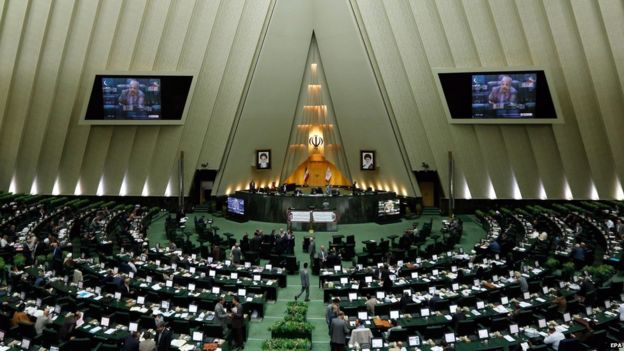
 Iran's parliament has approved draft legislation to ban access
to military sites and nuclear scientists

Ayatollah Khamenei also reiterated that he rejected allowing international inspectors to visit Iran's military sites, which Western countries suspect have been used for nuclear weapons research, or interviewing its nuclear scientists, five of whom have been assassinated.

"[The United States'] goal is to uproot and destroy the country's nuclear industry," he said. "They want to keep up the pressure and are not after a complete lifting of sanctions."

Earlier on Tuesday, Iran's parliament also approved draft legislation that would ban access to military sites, documents and scientists as part of any deal with the P5+1.

However, US state department spokesman John Kirby stressed on Tuesday that inspections of suspicious sites would be a key part of any agreement.

"For us, nothing's changed about what's necessary for a final deal, which includes access and transparency that will meet our bottom lines," he told reporters.

***

As if this would prevent Obama to capitulate even more...

Tuesday, June 23, 2015

Opinion Journal: Michael Oren’s Hard Truths


Listening to John Bolton and the Iranian threat, I was wondering how come Michael Oren decided tell the truth about the true nature of the Iranian threat, something that even Bret Stephens of the Wall Street Journal is reluctant to do? 

In his LA Times op-ed “Why Obama is wrong about Iran being ‘rational’ on nukes,” Oren writes: “As famed Middle East scholar Bernard Lewis once observed, ‘Mutually assured destruction’ for the Iranian regime ‘is not a deterrent – it’s an inducement.’” 

Now that I am reading his book, Ally, it becomes clear.   He writes “The program of Islamic philosophy, medieval and modern history, and Arabic, was rigorous, and my professors -   including the preeminent Middle East scholar, Bernard Lewis – superb.”


The question is why did it take him so long to quote Bernard Lewis on the death of the mutually assured destruction doctrine?