Translate

Wednesday, May 30, 2012

Ari Shavit on Obama


I’ve never read a more honest and better article on Obama than this one by Ari Shavit. Is anyone in the US taking note?  


The world should focus on Obama, not Netanyahu

By Ari Shavit May.24


President Barack Obama is a cool-headed leader. For the past 40 months he has known that history will judge him by his actions and failures vis-a-vis Iran. If he blocks the Iranian nuclear program, he will become a national hero like John F. Kennedy after the Cuban missile crisis. If he doesn't, he will become a grotesque figure.
And yet, the man sitting in the Oval Office is ignoring the possibility that his inaction will make the Middle East go nuclear and undermine the world order. He doesn't care that he might be responsible for losing the United States' superpower status and turning the 21st century into a century of nuclear chaos.
The dispassionate man from Chicago is proving every day what rare stuff he's made of. The president sees how the Iranians mock him - and does nothing. He sees radical Islam approaching the nuclear brink - and does not budge. With amazing courage Barack Obama watches the tsunami rolling toward America's shores - and smiles.
President Obama is an intrepid leader. For a year the man seeking a second term in the White House has known that a conflagration in the Middle East could determine the 2012 election campaign.
He is aware that due to an amazing coincidence, the technological, operative and strategic timetables are converging toward the end of this year. The president hears Israel telling him loud and clear that if the United States does not defuse the ticking bomb this summer, the Israel Air Force will have to do it. The president hears his best experts telling him loud and clear that the situation is very serious and Israel is very serious, so this summer is the summer of truth. And yet, the steely president is not batting an eye.
He is staging a deceptive show of a deal with the Iranians, which will seem to dull the Natanz threat. He is trying to make a fool of Jerusalem as Tehran is making a fool of him. The president is pushing Israel into a corner, but is hoping that Israel will accept its fate submissively. He is counting on Benjamin Netanyahu not to surprise him and ruin his election season. Never has the United States had such a gambler for a president.
President Obama is a thrifty president. America isn't what it used to be, but it still has vast strategic, economic and military resources. The United States can stop the Iranian nuclear program by using a small part of these resources.
But the extremely thrifty commander-in-chief is not prepared to pay any price for stopping the 8,000 Shi'ite centrifuges. That's why Obama didn't stand by the Iranian Spring of 2009 as he stood by the Arab Spring of 2011. That's why Obama didn't act firmly against the underground facility near Qom, which was discovered three years ago. That's why Obama has not touched, to this day, Iran's central bank, nor has he stopped the flow of oil distillates to the country's ports.
The cautious president sees not the catastrophic price the West will pay for Iran's nuclearization, but the political price he will pay if oil prices rise. Never in its history has the United States had such a thrifty leader as its 44th president.
The international community and international public opinion are preoccupied with King Netanyahu these days - will he or won't he attack? But instead of focusing on a statesman who isn't supposed to save the world from Iran's nuclear program, it would be better to focus on the leader whose historic role is just that. In the past 40 months Barack Obama has been betraying his office. Will he wake up in the next four months, come to his senses and change his ways?


Sunday, May 20, 2012

Why are Bernard Lewis's views on MAD being ignored?


Bernard Lewis's new book Notes on a Century : Reflections of a Middle East Historian was published ten days ago.  "Replete with exceptional historical insight that one has come to expect from the word's foremost Islamic scholar"  - THE WALL STREET JOURNAL.Actually, the book is replete with dry British humor and I could not stop laughing.  However, it also  discloses  excerpts  from the emails he had sent to Stephen Hadley, President Bush's National Security Advisor, but judging by the reviews this part (page 333) does not exist:


Particular importance should be attached to the policies, and perhaps still more the attitudes, of the present rulers of Iran, who seem to be preparing for a final apocalyptic battle between the forces of God [themselves] and of the Devil [ the Great Satan--the United States].  They see this as the final struggle of the End of Time and are therefore undeterred by any level of slaughter and destruction even among their own people . "Allah will know his own" is the phrase commonly used, meaning that among the multiple victims God will recognize the Muslims and give them a quick pass to heaven.

                In this context, the deterrent that worked so well during the Cold War, namely M.A.D. (Mutual Assured Destruction) , would have no meaning.  At the End of Time, there will be general destruction  anyway.  What will matter is the final destination of the dead-- hell for the infidels, and the delights of heaven for the believers. For people with this mindset, M.A.D. is not a constraint; it is an inducement...


Of the four reviews of the book I've read  in Tablet Magazine ,  Amazon ,  Wall Street Journal and  The Chronicle , not one mentions Bernard Lewis's opinions on MAD and Iran.  True, in a short review one cannot touch all the aspects of the book.  But surely what the leading scholar of Islam in the West has to say about the most crucial threat facing humankind today is worth a comment?  But the reviews completely ignore it .  It is not that the reviewers  of Notes on the Century  disrespect Bernard Lewis.   On the contrary.  They are aware of his background , the languages he speaks , the width and depth of knowledge he possesses.  The reviews are positive.  And  yet,  the reviewers  do not know what to do with MAD.  On the one hand, here is a most erudite, respected scholar  and on the other,  he is saying such, to them, off the wall things no one else dares to mention.  What to do? The best thing is to ignore it.  Perhaps if someone else in the media would volunteer and bring  up the topic, they would pitch in.   No one in the main stream media does.  So much for the information age we believe we live in. 

Video: Bernard Lewis on MAD in March 2009:


Transcript:
Dan Diker:

Professor Lewis, if Iran, as you say, is racing for regional supremacy and upending, destabilizing  Arab regimes with the same energy it plans to destroy Israel, what does it mean for places like Gaza and the West Bank. To what extend are they part of the Iranian plan, or how should we think about the closer battlefields to home?

Bernard Lewis:

I think one might divide them into two groups. On the one hand, you have the groups that are themselves Shi’a.  Shia are an important part of the population of Syria and Lebanon.  Hizballah is a Shi’at organization. Their link with Iran and the Iranian revolution is clear and obvious.  There are no Shi’a Palestinians.  And as I said before, where the distinction does not exist it is not important. That is why it is possible for groups of people in Muslim Africa, which is solidly Sunni, or among the Palestinians who are solidly Sunni, to take up the Iranian cause and  that is why I think we find that Hamas has accepted support from Iran  and is rallying to the Iranian cause, because for them, in their historical religious awareness the Sunni-Shi’a difference is not that important .

Dan Diker:

So therefore on balance, there Is a major debate, professor Lewis, that has been going on about this conflict, meaning in  the narrow sense meaning the Palestinian-Israeli conflict  as part of a subset of the Arab –Israeli conflict, that we are really in a ethno national conflict, some say, we are in political conflict, some say, but from what you are saying, to what extent are we in a religious conflict? 
          
Bernard Lewis:

I think in the Muslim perception it is basically a religious conflict. It is to decide who will dominate Islam , whose version of Islam will prevail in the Islamic world. And there  is no doubt that the Iranians have plans going far beyond the Middle East, and extending eastwards into south and south-east Asia, westwards into t Muslim Africa, and there are signs of that in various places. The impact has been enormous. As I said, t had the same kind of impact as the French and Russian revolutions in their days, with the same kind of response.

There is one other point, which I think I will mention if you would allow me, and that is what I would call the apocalyptic aspect.  In Islam, as in Judaism ,  as in Christianity, there is a scenario for the End of Time. When the final battle takes place between the forces of good and the forces of evil, of which for Christians, Jews and Muslims alike means between us and them, the us being differently defined and them being more or less the same. In the Muslim view, no, let me correct that, in the view of a certain section within the Iranian leadership, it is not by any means unanimous, that time is NOW. For a group called the Hujtieh whose main leader is Ahmadinejad, the apocalyptic time has come. The Mahdi, the Muslim Messiah is already here. The final battle between the forces of good and the forces of evil has already begun. 

That is extremely important for another, not immediately related reason. That is the question of Iran’s nuclear weapon. The Soviet Union had nuclear weapons right through the Cold War, but neither side used them because both sides were aware that if either one did  the other would do the same and this would lead to mutual destruction - MAD as it was known at the time. Mutual assured destruction was the main deterrent preventing the use of nuclear weapons by the Soviets   For most of the Iranian leadership MAD would work as a deterrent, but for Ahmadinejad and his group with their apocalyptic mindset mutually assured destruction is not a deterrent, it's an inducement and they believe that the End of Time has come, the final battles are already beginning  and the sooner the better, so that the good can  go and enjoy the delights of paradise and the divine brothel in the sky and the wicked, that means all of us here, will go to eternal damnation.

Dan Diker

On this point of Iranian ascendency and dedication to the End of Days, you have written, especially since 1976 when you wrote the “Return of Islam”, exactly two years before the Islamic revolution in Iran, first Islamic revolution in Iran. Many in the west of your colleagues have not seen it the way you’ve seen it. They have…

Bernard Lewis:

Not immediately

Dan Diker

You have expressed concern in your writings, from the Return of  Islam to The Roots of Muslim Rage, even to more recent articles that the West is not getting something about Islam. What are they missing?

Bernard Lewis:

It is normal for human beings to judge others by ourselves. We are now in the 21st century of the Christian era. They are in the early fifteenth century of the Muslim era. It is a different religion based on entirely different historical experience, different message, different teaching, and it is therefore a grave error to do what people normally do, and that is judge others by ourselves.  It does not work and it is dangerously misleading.  If one looks at Islam from within and for that it is necessary to learn at least one Muslim language, something which many Middle East experts, in fact most Middle East experts in the West, for one reason or another are reluctant to do, if one learns he languages and reads what they say among themselves, and understands it in the context of their own history, their own culture, their own background, then I think I is not too difficult to understand what is happening.  

Dan Diker:

Then why is it if Egypt, Saudi Arabia, the Gulf states, the Palestinian Authority in the West Bank are publicly condemning Iran and their servants, their Sunni and  Shiite servants  or proxies or surrogates, why is the Arab establishment unwilling to fight when they are so frightened of what they perceive is an existential  threat to them?

Bernard Lewis:

Because the Arab establishment as you call it consist mainly of rather unpopular autocracies. Looking at it from a western point of view, if you look around the Middle East you could divide the countries into two groups: countries with pro- western, lets be more specific, countries with more pro- American governments and therefore anti American populations and countries with ant-American governments and therefore pro- American populations, the second consisting essentially of Iran. We in the West are seen as the sponsors, the aiders and  abettors of the tyrannies that rule over them. Now I see at the moment that the regimes , the rulers of Egypt and others, see the threat and are therefore turning to Israel. That does not mean that the populations of those countries see it that way or are turning to Israel.  Take the specific case of what has been happening in Gaza.  Mubrak and his government, his whole ruling apparatus, feel mortally threatened by the pro- Iranian presence in the Gaza Strip and they are very happy to see it demolished, but that is not the case with the large part of the Egyptian population. I mean the Hamas people in Gaza are the part of the Muslin Brothers. The Muslim Brothers constitute a very significant opposition group within Egypt and Egyptian population. And there too Sunni-Shi’a business is not important. The revolutionary appeal, even the apocalyptic appeal of Shiism has some impact.


Saturday, May 12, 2012

Krauthammer - “Echoes of ‘67: Israel unites”


Although this blog is devoted exclusively to the doctrine of MAD, I could not ignore this excellent article by Charles Krauthammer in the Washington Post . In contrast to many, Krauthammer understands the essence of Netanyahu’s move to form a unity government.  While the rest of the US media is asleep, Krauthammer’s analysis is penetrating and accurate, his timing perfect.


By Charles Krauthammer

In May 1967, in brazen violation of previous truce agreements, Egypt ordered U.N. peacekeepers out of the Sinai, marched 120,000 troops to the Israeli border, blockaded the Straits of Tiran (Israel’s southern outlet to the world’s oceans), abruptly signed a military pact with Jordan and, together with Syria, pledged war for the final destruction of Israel.
May ’67 was Israel’s most fearful, desperate month. The country was surrounded and alone. Previous great-power guarantees proved worthless. A plan to test the blockade with a Western flotilla failed for lack of participants. Time was running out. Forced into mass mobilization in order to protect against invasion — and with a military consisting overwhelmingly of civilian reservists — life ground to a halt. The country was dying.
On June 5, Israel launched a preemptive strike on the Egyptian air force, then proceeded to lightning victories on three fronts. The Six-Day War is legend, but less remembered is that, four days earlier, the nationalist opposition (Mena­chem Begin’s Likud precursor) was for the first time ever brought into the government, creating an emergency national-unity coalition.
Everyone understood why. You do not undertake a supremely risky preemptive war without the full participation of a broad coalition representing a national consensus.
Forty-five years later, in the middle of the night of May 7-8, 2012, Prime Minister Benjamin Netanyahu shocked his country by bringing the main opposition party, Kadima, into a national unity government. Shocking because just hours earlier, the Knesset was expediting a bill to call early elections in September.
Why did the high-flying Netanyahu call off elections he was sure to win?
Because for Israelis today, it is May ’67. The dread is not quite as acute: The mood is not despair, just foreboding. Time is running out, but not quite as fast. War is not four days away, but it looms. Israelis today face the greatest threat to their existence — nuclear weapons in the hands of apocalyptic mullahs publicly pledged to Israel’s annihilation — since May ’67. The world is again telling Israelis to do nothing as it looks for a way out. But if such a way is not found — as in ’67 — Israelis know that they will once again have to defend themselves, by themselves.
Such a fateful decision demands a national consensus. By creating the largest coalition in nearly three decades, Netanyahu is establishing the political premise for a preemptive strike, should it come to that. The new government commands an astonishing 94 Knesset seats out of 120, described by one Israeli columnist as a “hundred tons of solid concrete.”
So much for the recent media hype about some great domestic resistance to Netanyahu’s hard line on Iran. Two notable retired intelligence figures were widely covered here for coming out against him. Little noted was that one had been passed over by Netanyahu to be the head of Mossad, while the other had been fired by Netanyahu as Mossad chief (hence the job opening). For centrist Kadima (it pulled Israel out of Gaza) to join a Likud-led coalition whose defense minister is a former Labor prime minister (who once offered half of Jerusalem to Yasser Arafat) is the very definition of national unity — and refutes the popular “Israel is divided” meme. “Everyone is saying the same thing,” explained one Knesset member, “though there may be a difference of tone.”
To be sure, Netanyahu and Kadima’s Shaul Mofaz offered more prosaic reasons for their merger: to mandate national service for now exempt ultra- Orthodox youth, to change the election law to reduce the disproportionate influence of minor parties and to seek negotiations with the Palestinians. But Netanyahu, the first Likud prime minister torecognize Palestinian statehood, did not need Kadima for him to enter peace talks. For two years he’s been waiting for Mahmoud Abbas to show up at the table. Abbas hasn’t. And won’t. Nothing will change on that front.
What does change is Israel’s position vis-a-vis Iran. The wall-to-wall coalition demonstrates Israel’s political readiness to attack, if necessary. (Its military readiness is not in doubt.)
Those counseling Israeli submission, resignation or just endless patience can no longer dismiss Israel’s tough stance as the work of irredeemable right-wingers. Not with a government now representing 78 percent of the country.
Netanyahu forfeited September elections that would have given him four more years in power. He chose instead to form a national coalition that guarantees 18 months of stability — 18 months during which, if the world does not act (whether by diplomacy or otherwise) to stop Iran, Israel will.
And it will not be the work of one man, one party or one ideological faction. As in 1967, it will be the work of a nation.

However, when I read the comments to Krauthammer’s article I was appalled by the ignorance in assessing the situation. Krauthammer got it right. But he seems to be in the very small minority. This is probably the consequence of the US media‘s reluctance for decades to discuss Islam in general and Shia eschatology in particular. To most people the idea that Iranian mullahs may indeed desire to start a nuclear war in order to bring about the return of the Mahdi, the Hidden 12th Imam, seems so preposterous that anyone who even mentions it must be considered insane. Their reasoning is that if there were any remote truth in this the media would write about it, but since they don’t then this must all be nonsense. Case closed. 
 
A scholar of Islam like Bernard Lewis, Professor Emeritus at Princeton, the author of some 30 books on Islam, who spent the last 60 years in the study of Islam and who believes that Iran cannot be deterred is dismissed as an extremist by the readers, most of whom have never read the Koran and have no idea that the Twelvers even exist. 
 
I can only compare such levels of mass ignorance to the population of the USSR where I spent six years in the 1970s.  At least in the USSR there many were eager to tune in to foreign broadcasts and hear what was really happening or read an occasional copy of The Economist  to which my father was subscribed  to. In the US today the vast majority thinks it is well informed by reading the New York Times or the Washington Post and never ventures to look for more info although it is at their fingertips.  

 
Now that the unity government is formed I guess Netanyahu will wait until May 24 to see what is going on with the Iranian/5p+1 talks and then we can expect an attack on the Iranian nuclear sites at any time. Many in the US will have absolutely no idea why Israel had to do it. 

Saturday, May 5, 2012

Is the Death of MAD such a hot potato topic?

Through the years I got used to the fact that Ha’aretz censors most, if not all my talkbacks. One of the few they ever allowed through was my comment that A.B. Yehoshua should get the Nobel Prize instead of Amos Oz since his Mr. Mani is a masterpiece.

But now I see that the Jerusalem Post has begun to censor me as well.  I feel as if I were in the movie The Lives of Others.  The comment appears but next time I click the link it is no longer there. Faster than Winston Smith in 1984 threw the photos of the newly declared non-persons into the memory hole.    

There is still a possibility that this has been a series of technical glitches in the last few weeks,  but the probability of this  happening is the product of the  probability of each individual disappearance being a glitch – and that is very, very small.       
                       
Here is my latest disappearing comment as a response to the article in the Jerusalem Post

'Israeli strike on Iran would inevitably draw in the US’   


"A nuclear Iran is much more dangerous than attacking Iran," Yadlin concluded. Finally a reasonable comment.

No one but Israel is being put in a situation where the only other choice apart from a preemptive strike against the Iranian nuclear sites is the choice of being incinerated by an undeterred, return of the Mahdi seeking Iranian leadership, who are according to Bernard Lewis looking forward to a mutually assured destruction.  Google MAD is Dead.  

Calling early elections so that Netanyahu can have room to make crucial decisions without Obama breathing down his neck is a good move if Israel can wait another 4 months. Hopefully, stuxnet, duqu and other variations of the computer worm, like Ultra  against Enigma in WWII, have given Israel sufficient information of the state of the Iranian nuclear program to take this very high risk. The stakes are enormous but Netanyahu by defending Israel and through the worlds complacency is bound to become the Leader of the Free World.  

Friday, April 27, 2012

Netanyahu's interview with CNN


Here is the transcript of the Iran related part of the interview:
ERIN BURNETT OUTFRONT
Aired April 24, 2012 - 19:00   ET
THIS IS A RUSH TRANSCRIPT. THIS COPY MAY NOT BE IN ITS FINAL FORM AND MAY BE UPDATED.


(BEGIN VIDEOTAPE) 

BURNETT: Mr. Prime minister, thank you so much for inviting us and letting us come and see your home. 

BENJAMIN NETANYAU, ISRAELI PRIME MINISTER: Well, welcome to Jerusalem. Take a look around. 

BURNETT: We came here to your courtyard. I know we had to move -- there was a table here earlier, when we got here, there were two coffee cups on it, I guess it was yours and Tony Blair's, when you were talking this morning, but how important is this space for you? This is sort of your -- this is your getaway space, right? 

NETANYAHU: No this is my prison courtyard, because the prime minister of Israel, like I suppose the president of the United States, and maybe the Pope one or two other people. 

BURNETT: Does it ever feel like you're sort of under house arrest? I mean this -- 

NETANYAHU: Yes, for good reason, but I suppose so. But it doesn't mean that there aren't an endless number of people who want to get into this prison cell -- 

BURNETT: Oh I'm sure -- 

NETANYAHU: -- and live here. 

BURNETT: I'm sure there are. Iran, there's been 16 years of diplomacy as you've talked about. You've said repeatedly, you said it in March; I know you said it to the Army radio this morning. It is not a problem of days but it's also not a problem of years. Now you said that first in March so I would imagine not years, plural. That means you think this will be resolved by next spring? 

NETANYAHU: Well, I hope it is resolved and I hope it is resolved peacefully. Certainly the international community is putting a lot of pressure on Iran and making clear that its nuclear program must stop. If it stops with the sanctions, the combinations of sanctions, diplomacy, other pressures, I, as the prime minister of Israel, will be the happiest person in the world. 

BURNETT: Do you think that sanctions are working? I mean, I saw a story today that about -- I think it was 56 percent of Iranian -- of Iran's fleet, tankers, sitting off the coast with oil, full of oil, because they can't sell it. It would appear that sanctions are working. 

NETANYAHU: Well, they are certainly taking a bite out of the Iranian economy but so far they haven't rolled back the Iranian program or even stopped it by one iota
. I mean, I hope that changes, but so far, I can tell you the centrifuges are spinning. They were spinning before the talks began recently with Iran. They were spinning during the talks. They're spinning as we speak. So, if the sanctions are going to work, they better work soon. 

BURNETT: How do you know what they're doing? 

NETANYAHU:
Oh, we know. 

BURNETT: You know? 

NETANYAHU
: We know and others know and we share what we know. This is not the case of the questions that people had about Saddam Hussein. 

BURNETT: They say that it is for peaceful purposes -- 

NETANYAHU: They stay it is for peaceful purposes. 

BURNETT: They say it is for peaceful purposes. NETANYAHU: Well you have a sense of humor. I mean they said it is for medical isotopes, right? That's why they are developing ICBMs to carry medical isotopes to Europe or Israel or the United States. That's why they are building these underground bunkers between -- underneath mountains for medical isotopes. You know that's why they are telling the world that they are going to erase Israel, with the medical isotopes. This is a farce. Nobody can seriously -- nobody can take them seriously. 

BURNETT: No nations with nuclear weapons have ever gone to war with each other. I mean, take India and Pakistan. They haven't used them. Could it be that Israel and Iran could end up in a situation like that where the acquisition of the nuclear weapon ensures it would never be used? 

NETANYAHU: Well, I'm not going to comment on Israel's purported capabilities. I will say that to date, since the advent of the nuclear age after Hiroshima all nuclear powers have been very careful with the use or more accurately, the nonuse of the nuclear weapon when it comes to militant Islamic regime, I wouldn't be too sure
. Because unlike, say the Soviets, they can put their ideology before their survival, so I don't think you can bet on their rationality. Iran has given its terror proxies Hamas in Gaza and Hezbollah in Lebanon, it's given them the most advanced lethal weapons, whatever weapons they have to give them and they fired now 10, 12,000 rockets on Israel's cities. 

They've been helping them to murder diplomats worldwide and to kill American soldiers in Afghanistan. Think of what they do with nuclear weapons
. And I don't think you want to bet the peace in the Middle East and the security of the world on Iran's rationale behavior. I think it is a much safer bet to do what I and President Obama and others have said, prevent Iran from acquiring atomic bombs. 

BURNETT: One thing it's interesting though and you talk about some of the negative parts about the regime there is a Jewish member of parliament in Tehran and one of the most popular soap operas there, there was a zero degree turn or zero turn, main character, an Iranian falls in love with a Jewish woman. He helps smuggle Jews out of Paris to save them from the Holocaust. And it's very popular in Iran. What makes you so sure that they are anti-Semitic in a way that would cause them to use the weapon against Israel? 

NETANYAHU: Well I'd draw a distinction between the people of Iran and the regime that has terrorized (ph) them, taken over their lives.

BURNETT: The regime let the show air though. 

NETANYAHU: Well the regime is the one that, you know, has to kill people in the streets and goes into their homes after they cull (ph) the Internet and they just make people disappear. So this is a regime that is very brutal to its own people. Iran is not free. Jews in Iran have a lot to worry about. But the Jewish state that Iran openly calls a cancer that has to be excised from the Middle East that has to be eradicated, certainly must take seriously Iran's claims to annihilate it. 

BURNETT: The way the talks seem to be going, U.N. negotiators, U.S. negotiators, Iranian negotiators, (INAUDIBLE) saying that the sanctions are working and that they may, in fact, roll back some sanctions. That's what the Iranians want and there has not been a direct rebuttal to that from the other side, the really tough sanctions that are supposed to take effect this summer -- 

NETANYAHU: Well I think it would be a big mistake -- 

BURNETT: What do you do -- OK.

NETANYAHU: I think it would be a big mistake to rescind the sanctions or lighten the sanctions. I think there has to be a cascade of sanctions and so far, that's the acid test
, the sanctions haven't worked. How do we know that? Because nothing has been stopped. What has stopped in the Iranian program? 

BURNETT: What if they halted full enrichment to 20 percent started importing that, would that be enough? 

NETANYAHU: I think what they need to do are three things. One, they have to stop all enrichment, second to take the -- 

BURNETT: All enrichment, even the three percent for medical? 

NETANYAHU: Yes. Yes, because they say they need it for what medical isotopes? So you can -- the second point is after you stop all enrichment is remove the enriched material and you will get these rods from another country that can allow you to use nuclear energy for peaceful purposes. And third, dismantle the underground bunker (INAUDIBLE). If they have no military goals, they should respond to this readily. What we want are factual results. We want to see the Iranian program rolled back.
That's, unfortunately, not achieved by talks in which Iran has one goal, to stall, delay, run out the clock. That's basically what they are doing. 

BURNETT: Do you worry that you are going to put yourself in a position though that you may have to strike, a strike which even former head of the Mossad has said would only delay, not end the Iranian nuclear program? That by staying is not days, it's not -- you are going to end up with a date where if you don't do it, you look like you couldn't or you wouldn't so you have to? 

NETANYAHU
: I'm not worried what we look like. I am worried about stopping this. And I think there are really three principles that should guide us. They have been echoed by the United States and I think any sensible person understands that. The first is that Iran's nuclear weapons program must be stopped. The second is that containment is not an option. And the third is that Israel, the state of the Jewish people, must have the capacity to defend itself by itself against any threat.

(END VIDEOTAPE) 

Thursday, April 26, 2012

Alan Dershowitz on MAD


Alan Dershowitz in Newsmax brings an unexpected perspective to the discussion on the inapplicability of MAD with regards to Iran. However, I believe Dershowitz is wrong and that the death of MAD is due not to the Israelis being ethically incapable of actually launching a nuclear counter attack at Iran but because Iran could not care less if they did.   


Why Deterrence Won’t Work Against Iran  

By Alan Dershowitz
Alan M. Dershowitz's Perspective: Following President Obama’s strong renunciation of “containment” and his expression of willingness to use military force as a last resort to prevent Iran from developing nuclear weapons, some on the left continue to oppose any threat to use the military option.

Leading this approach is Fareed Zakaria, who recently on his CNN program, characterized the Obama policy as “a serious error,” and called instead for a “robust policy of containment and deterrence.”
But the policy that Zakaria is proposing is anything but robust. To the contrary, it is a call for inaction. It presumed that Iran will be allowed to develop nuclear weapons, but that it will be deterred from actually using them by the threat of nuclear retaliation.

Zakaria points to the fact that deterrence succeeded in preventing war between the United States and the Soviet Union, as well as between India and Pakistan. He claims that each side was effectively deterred by the threat of mutually assured destruction. He says it will work equally well with Iran.

Let us pause for a moment to understand precisely what a policy of deterrence entails. Any such policy is based on the promise that if one side launches a nuclear attack, the other side will retaliate with an equally devastating nuclear attack, thus assuring the destruction of both societies and the deaths of millions of innocent civilians.

The first question therefore is whether the United States would actually be willing to retaliate against a nuclear attack on Israel by dropping nuclear bombs on Tehran, killing millions of its civilian inhabitants. The second question is whether any civilized country — the United States or Israel — should be willing to kill millions of Iranian civilians because their leaders made a decision to use nuclear weapons against Israel or the United States.

The third question — and the one never asked by advocates of deterrence — is whether it would be legal under the laws of war to target millions of civilians in a retaliatory nuclear attack.

These are the kinds of questions that Fareed Zakaria and his dovish colleagues refuse to ask. And the reason they refuse to ask these hard questions is precisely because we know the answers they would give: They would be categorically opposed to any retaliatory attack that targeted civilians in a tit-for-tat implementation of a mutually assured destruction policy of deterrence.

If you don’t believe me, ask him!

As to the legality of nuclear deterrence, the International Court of Justice issued a decision in 1996, in a case challenging the lawfulness of using, or threatening to use, nuclear weapons. The majority decision declined “to pronounce . . . on the practice known as ‘the policy of deterrence.’” It did rule unanimously, however, that any “threat or use of nuclear weapons” must “be compatible with the requirements of the international law applicable in armed conflict, particularly those of the principles and rules of international humanitarian law . . . ”

These rules, of course, generally forbid the targeting of civilian population centers and require proportionality even in the bombing of military targets. Since nuclear weapons are, by their nature, virtually incapable of destroying military targets without also inflicting countless civilian casualties, it would seem to follow that they could not be used except against remote military targets, such as ships and submarines on the high seas, or armies in isolated deserts or mountains. In a divided vote, the court ruled that:

• “The threat or use of nuclear weapons would generally be contrary to the rules of international law applicable in armed conflict…”

• “However, in view of the current state of international law, and of the elements of fact at its disposal, the court cannot conclude definitively whether the threat or use of nuclear weapons would be lawful or unlawful in an extreme circumstance of self-defense in which the very survival of a state would be at stake.”

In other words, it would be unlawful for the United States to threaten or use nuclear weapons as a deterrent, since its “very survival” would not be at stake, but it might be lawful for Israel to do so because it is a small state whose very survival would, in fact, be at stake were it to be attacked by nuclear weapons.

Menachem Begin, the Israeli prime minister who ordered the preventive attack on Iraq’s nuclear reactor in 1981, expressly renounced mutually assured destruction as a policy. He said that Israeli “morality” would never permit a retaliatory attack against an Iraqi city: “The children of Baghdad are not our enemy.”

A preventive attack, on the other hand, is always directed against a military target. Only one person — a nuclear technician — was killed in the attack Begin authorized.

It would appear to be ironic that Zakaria, and others who purport to be “doves,” would favor a mutually assured destruction policy that threatens the deaths of millions, over a preventive policy that targets military nuclear facilities. But it is not at all ironic, since such doves would be against actually carrying out the threat that is central to any credible policy of deterrence. For them, deterrence is a bluff — a hollow threat and the Iranians would see right through it.

That’s why President Obama is correct in renouncing containment and insisting that he isn’t bluffing when he says Iran will not be allowed to develop nuclear weapons, even if it takes a surgical military strike to stop them.

I am not here arguing in favor of a preventive attack on Iran at this time. I am arguing against reliance on a policy of deterrence and containment, because I don’t believe it will work in relation to Iran, Israel, and the United States.

What if deterrence and containment didn’t work and Iran were to fire nuclear rockets at Israeli cities? Those who now advocate robust deterrence — of surgical prevention — would simply say to the remaining Israelis: “Woops. We were wrong. Sorry. We’ll build you a new Holocaust Museum.”


Friday, April 20, 2012

Israeli leaders understand the concept of takkiya


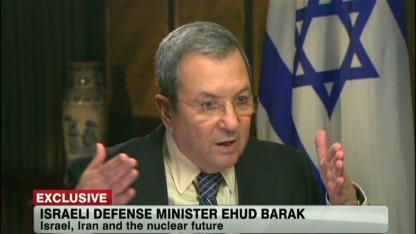
Amazing! Last night in an interview with CNN Ehud Barak, Israel’s defense minister, demonstrated that he understood what takiyya meant.  This shows that the Israeli leadership understands Islamic concepts used by Iran to confuse and deceive the gullible West.  Only two months ago Ari Shavit in an article in Ha’aretz revealed that Netanyahu held in-depth discussions with Bernard Lewis who convinced Netanyahu that if the ayatollahs obtained nuclear weapons they would use them. 

In contrast to President Obama and the Europeans, Israel’s leaders know what they are doing.  


From the Jerusalem Post:
Barak mentioned a Muslim notion called takkiya, which he said grants Muslims the right to lie in order to deceive non-Muslims, for the sake of the religion.


From CNN:
Aired April 19, 2012 - 15:00:00   ET

THIS IS A RUSH TRANSCRIPT. THIS COPY MAY NOT BE IN ITS FINAL FORM AND MAY BE 

UPDATED.

AMANPOUR: Right now there is an enormous amount of talk and focus about the fatwa by Iran's Supreme Leader, who's in charge of all the program, not only Iranians are talking about the fatwa, in which he said that Iran would not possess, would not develop, it's a great sin under Islam to have a nuclear weapon or anything, of weapons of mass destruction. 

But it's not just him. It's Secretary of State Hillary Clinton. It's even President Barack Obama. It's the prime minister of Turkey. It's many people now talking about this fatwa as if it could be some kind of diplomatic exit, an offramp to the crisis.

BARAK: I don't buy it so easily. It is the same Khamenei who said just a year ago, his quote, Gadhafi for buying so easy the pressure to give -- to give up his nuclear (inaudible). He pointed to where he is now. 


Have you heard the term atakia (ph), which means in Islam, especially in the Shia, a kind of permission from heaven to the leader to lie and mislead. (Inaudible) as long as it's really in order to reach the objective, the political objectives of the movement agobo (ph), the tribal (inaudible) of the nation. So it's -- I don't buy it.

I follow the facts on the ground, enrichment continues. They got a pose (ph) of five months, five weeks until the next (inaudible). But, God (ph), everything is still working. It is clear to all of us, to (inaudible) whoever that the Iranians are focused on, which in nuclear military capability, they are already as ever to defy and deceive the whole world.
AMANPOUR: You're obviously very concerned, and so are many, should Iran get a nuclear capability that's military. As I said, the U.S. does not believe any such decision has been made. But there are people --

BARAK: No, no, no. The -- I want to correct you.

AMANPOUR: But that's what they tell us.

BARAK: No, no, listen. Ask them the following question. Are they --

(CROSSTALK)

AMANPOUR: -- their intelligence doesn't --

BARAK: No, no. I know, I'm talking for the American intelligence. I've talked to American leaders. There is no difference in the assessment of intelligence. It's true that probably Khamenei did not give an order to start building a weapon or a device. 

But why he's doing this, just because he understands that if he starts to break the IEA and start to actually build a weapon, he might find himself faced with an American response, your response or whatever, in a way that might damage him. And that's the only reason why he did not give the order. But they're clearly heading toward this objective.

AMANPOUR: But if that's the case, then, then surely the pressure is working, that they're not doing it, as you said, because the pressure is there and the threat of (inaudible) what you might do.

BARAK: These are quite effective sanctions. But it's still far away from working.


AMANPOUR: I just want to go back to the fatwa in regard to what you've just said. As I said, many American officials are talking publicly about the fatwa. And there is a thought that President Obama might agree to allow Iran a civilian enrichment program if they can back up their fatwa and prove that they're not going to go the military route. Would you accept that?

BARAK: There's only (inaudible) fatwa if they stop enriching for 20 percent. They stop bringing out of country to a friendly mutually-agreed (ph) state.


One more observation.  Even after Barak mentioned takkiya and the fact that he does not buy anything Iran says Amanpour continues to mention the fatwa as if his answer went completely undetected by her. Either she is faking that she does not understand what Ehud Barak had  just said or she really is incapable of comprehending what he is saying since she automatically rejects this as total nonsense. 


Definition of taqiyya from Sharia: The Threat to America

12. Lying/Taqiyya: It is permissible for a Muslim to lie, especially to non-Muslims, to 
safeguard himself personally or to protect Islam.  

• “Let not the believers take the disbelievers as friends instead of the believers, and 
whoever does that, will never be helped by Allah in any way, unless you indeed 
fear a danger from them.  And Allah warns you against Himself, and to Allah is 
the final return.” (Q 3:28) 

• “‘Unless you indeed fear a danger from them’ meaning, except those believers who 
in some areas or times fear for their safety from the disbelievers.  In this case, 
such believers are allowed to show friendship to the disbelievers outwardly, but 
never inwardly.…‘We smile in the face of some people although our hearts curse 
them.’” (Tafsir Ibn Kathir, Vol 2, 141)  

• “Mohammed said, ‘War is deceit.’”  (Bukhari vol.4:267 and 269) 

• “He who makes peace between the people by inventing good
saying good things, is not a liar.”   (Bukhari vol.3:857 p.533)